Propulsive Landing
Landing on rockets alone — the only way down on an airless world like the Moon, and how a giant like Starship will set down on Mars.
101 · zoom in
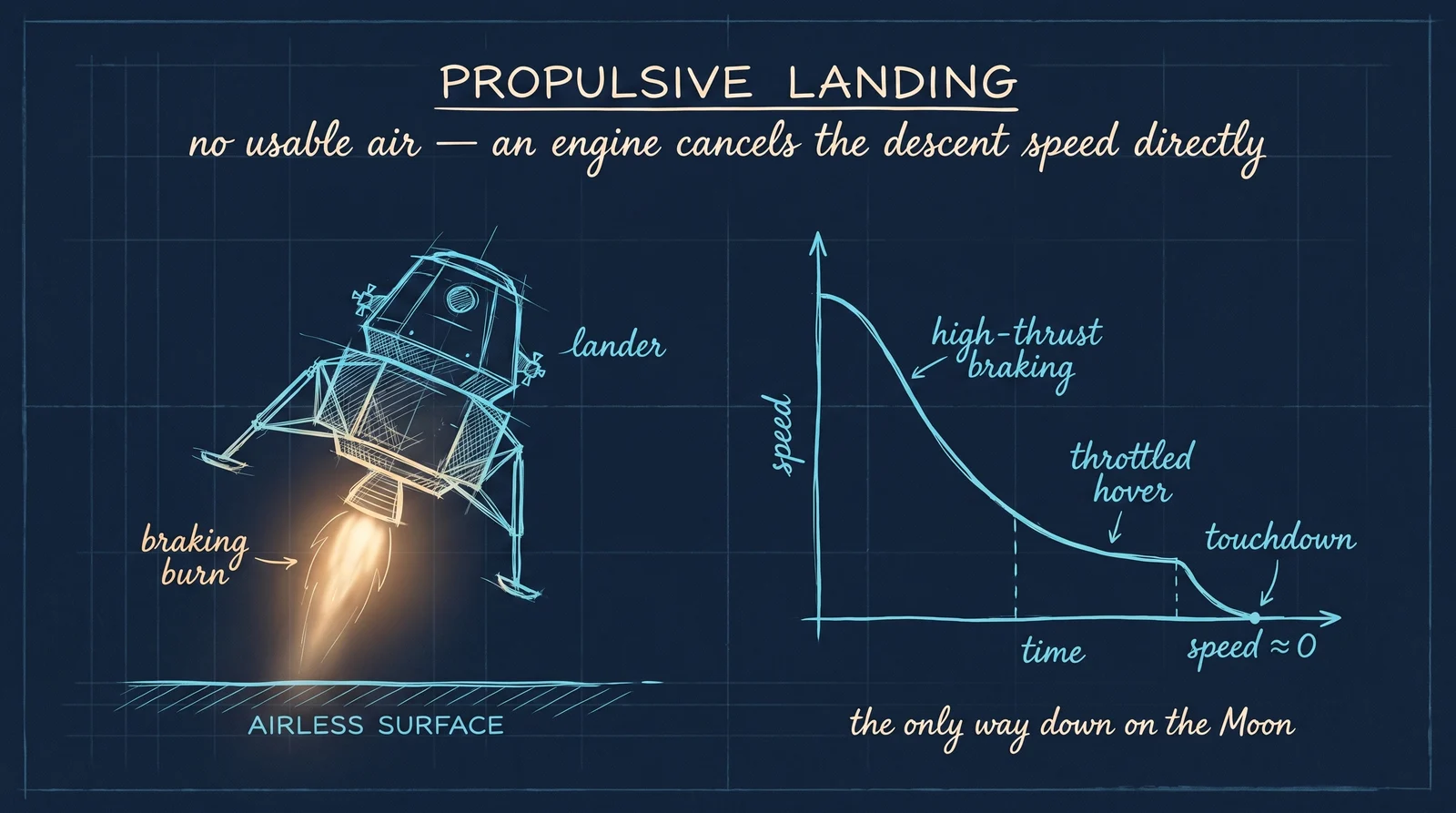
On a world with no air, there is nothing for a parachute to grab. The only way to slow down is to point an engine at the ground and burn — trading propellant for every metre per second of speed you need to cancel. This is propulsive landing, and it is how every Moon lander from Apollo to today has touched down: a long braking burn, then a gentle throttled hover to the surface.
It is unforgiving. Carry too little propellant and you run out before you stop; throttle wrong and you either slam down or climb back up. The engine has to be deeply throttleable, the guidance has to solve the fuel-versus-time problem in real time, and there is no second chance — you cannot re-deploy a parachute. Apollo's crews watched the fuel gauge fall toward empty as they hunted for a safe spot.
Mars sits in between. Its air is thin — enough to help a light lander with a parachute, but useless for a vehicle as massive as SpaceX's Starship. For those, the plan is propulsive all the way: a hypersonic entry to bleed most of the speed on the heat shield, then a landing burn to the surface, no parachute at all — much like landing on the Moon, but arriving through a whisper of atmosphere.
The propellant cost is set by the rocket equation and the speed to cancel. On the Moon a lander must kill its full orbital or approach speed on the engine, which is why so much of a lunar lander's mass is fuel. On Mars the atmosphere does the expensive first half for free (the heat shield), leaving the engine to handle only the final, slow kilometres — but for a heavy vehicle even that is a large burn.
Throttling is the heart of it. A landing engine must run smoothly from full thrust down to a fraction of it, so the vehicle can match a falling descent-rate schedule and settle to walking pace at the ground. Deep-throttle engines (the Apollo descent engine, the sky-crane's MLE thrusters, Starship's Raptors) are what make a controlled touchdown — rather than a controlled crash — possible.
On `/fly`, every Moon landing in `?descent=1` is propulsive from start to finish (no chute in vacuum), and the Starship Mars profiles brake on the heat shield then land on their engines. The descent HUD's retro indicator + the fuel readout track the burn — the same problem Apollo's crews solved by eye, now shown as live telemetry.
SEE IN THE APP
- /fly Watch a lunar or Starship landing in ?descent=1 — no parachute, rockets all the way to the surface