The interplanetary internet — networking across the light-lag
Standard internet protocols fail across light-minutes and planetary occultations; Delay/Disruption-Tolerant Networking solves this with store-and-forward bundles that wait for the next available link.
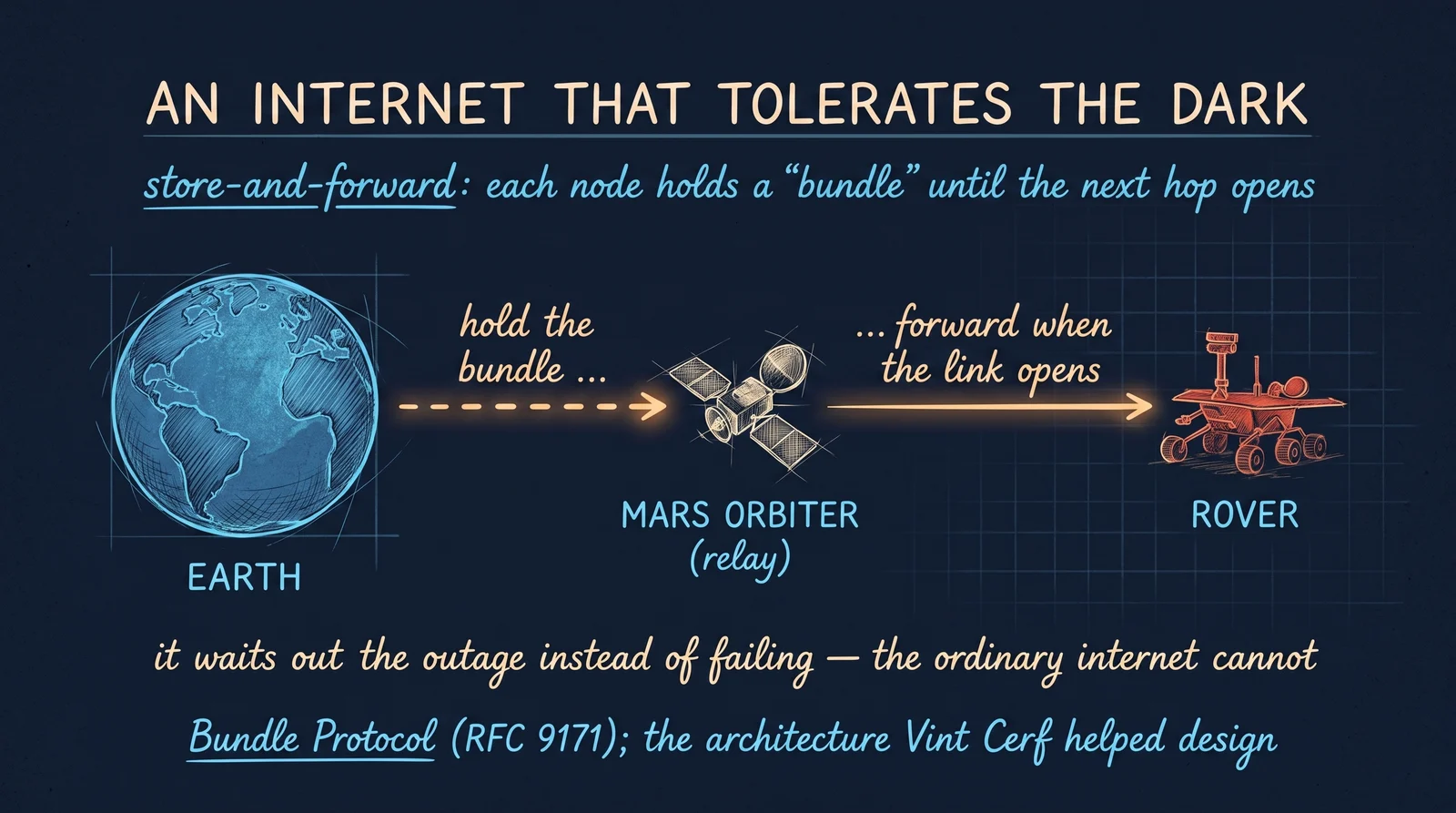
The ordinary internet assumes you can send a packet, wait a fraction of a second for an acknowledgement, and resend if it doesn't arrive. That model breaks catastrophically in deep space. A radio signal from Earth takes 4–24 minutes to reach Mars depending on orbital geometry; during planetary conjunction the link drops entirely for weeks. TCP/IP's round-trip assumption means a session times out and fails long before a single exchange completes.
Delay/Disruption-Tolerant Networking (DTN) solves the problem with a different architecture. Instead of maintaining an end-to-end connection, each node in the network holds a self-contained data 'bundle' — a unit containing routing metadata, expiry times, and the payload — and forwards it only when a suitable link is available. The node stores the bundle indefinitely if no link is currently open, then delivers it when the next contact window opens. The protocol is standardised: the Bundle Protocol is an IETF standard (RFC 9171). Its groundwork — the delay-tolerant networking architecture, RFC 4838 — was laid in part by Vint Cerf, one of TCP/IP's original architects, working with NASA/JPL.
DTN is already operational, not experimental. The ISS has run a DTN node since 2016, demonstrating the architecture in a real constrained-link environment. In deep space, Mars orbiters act as the relay tier: NASA's Mars Reconnaissance Orbiter, MAVEN, and ESA's Trace Gas Orbiter each carry store-and-forward relay capacity, passing bundles down from orbit to surface rovers and back up to Earth. The rovers don't talk directly to Earth for high-volume data — the orbital relay handles it, storing the downlink until a contact window with a DSN antenna opens.
DTN does not beat the speed of light. A bundle from a Mars rover still takes 4–24 minutes to reach Earth; DTN just guarantees it arrives eventually, without losing data during the inevitable gaps. What it adds is reliability and asynchrony: science data queued on a rover during a dust storm or an occultation is delivered intact when the link reopens, without requiring a human operator to manually schedule retransmissions.
SEE IN THE APP
- /missions Mars Reconnaissance Orbiter and MAVEN — act as DTN relay nodes for surface rovers