Ballistic Coefficient
The single number — mass divided by drag area — that decides how fast a spacecraft falls through an atmosphere, and whether it can stop in time.
101 · zoom in
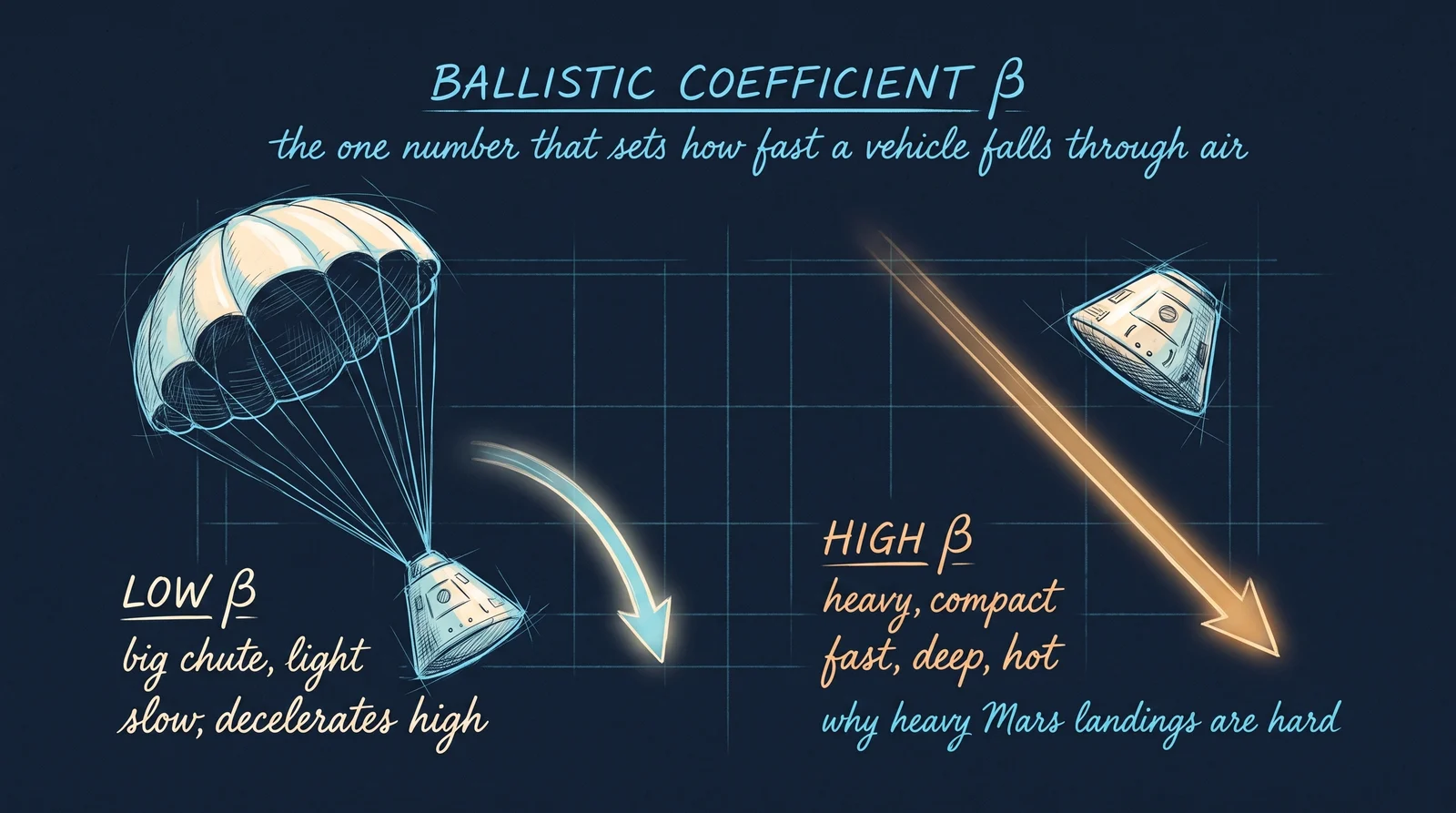
Drop a feather and a hammer in air and the feather drifts down while the hammer plummets. The difference is the ballistic coefficient: how much mass each carries behind how much drag area. A low ballistic coefficient (lots of drag, little mass) falls slowly; a high one (compact and heavy) falls fast. It is the one number that most shapes how a spacecraft comes down.
Landing engineers spend enormous effort keeping the ballistic coefficient low. A blunt heat shield, a huge parachute, an inflatable decelerator — all are ways to add drag area without adding much mass, so the vehicle sheds speed higher up where there is more air-column left to work with. The bigger and heavier the payload, the harder this fight becomes.
This is the quiet reason Mars is so hard. Its air is thin, so even a large parachute on a modest lander only bleeds the speed so far — the ballistic coefficient is too high to stop on drag alone. Every Mars lander needs a second act (retro-rockets, airbags, a sky-crane), while a light probe at Venus, in dense air, can drift down on drag alone.
Formally the ballistic coefficient is mass ÷ (drag coefficient × reference area). Terminal velocity scales with its square root, so halving the ballistic coefficient slows the fall by about 30%. Peak deceleration and peak heating both rise with it too — a heavier, more compact entry hits the atmosphere harder and hotter, which is why big vehicles face the worst of both.
It also sets WHERE in the descent the action happens. A low-ballistic-coefficient vehicle decelerates high up, in thin air, giving more time and altitude for the terminal phases. A high one carries its speed deep into the atmosphere before drag catches up, compressing the whole sequence into the last few kilometres — exactly the squeeze that makes a heavy Mars landing a race against the ground.
On `/fly`, the contrast is visible across bodies in `?descent=1`. A light Mars lander under a big parachute (low ballistic coefficient) settles gently; a 100-tonne Starship (very high) must brake propulsively; a Venus probe in thick air drifts down on a small drag plate. Same physics, three ballistic coefficients, three very different descents.
SEE IN THE APP
- /fly Compare a light chuted lander with a heavy propulsive one in ?descent=1 — different ballistic coefficients, different descents