Deorbit & the Re-entry Corridor
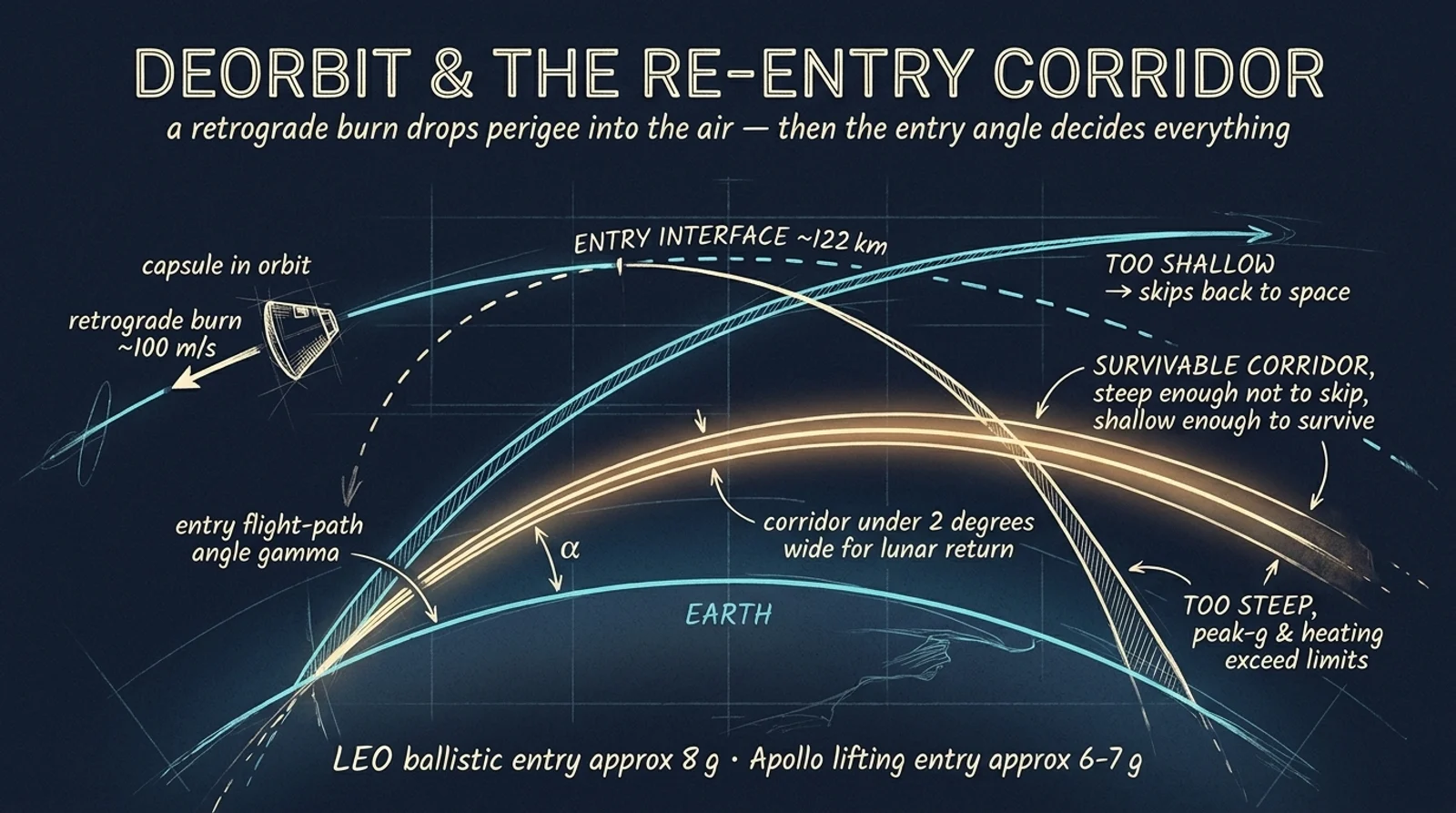
A capsule doesn't fall out of orbit — it's nudged into a corridor barely a degree wide, where too steep burns the crew up and too shallow skips them back into space.
101 · zoom in
Being in orbit means going sideways fast enough that you keep missing the ground. To come home you don't point down and dive — you slow down. A short retrograde burn, firing the engine against the direction of travel, shaves off only about a hundred metres per second. That's all it takes: the low point of the orbit now dips into the top of the atmosphere, and from there the air does the rest of the braking.
The catch is the angle you arrive at. Come in too shallow and the capsule grazes the atmosphere like a stone skipped across a pond — it bounces back out into space, and the crew loops around for another lap they may not have air or power for. Come in too steep and the air brakes them so violently that the deceleration crushes the crew and the heat shield can't shed the heat fast enough. Between those two failures is a safe band — the re-entry corridor — and for a capsule returning from the Moon it was famously less than two degrees wide.
So the whole return is a targeting problem solved before the burn ever happens. Get the deorbit burn's size and timing right and the capsule threads the corridor: steep enough not to skip, shallow enough to survive. Everything after entry interface — the fireball, the blackout, the parachutes — is just physics playing out along a path that was locked in the moment the engine shut down.
Deorbit is a retrograde impulse that lowers perigee from orbital altitude to inside the sensible atmosphere — for a low-Earth-orbit capsule, dropping perigee to roughly 40–60 km with a burn of only ~100 m/s. The vehicle then coasts, unpowered, down to entry interface at about 122 km, where aerodynamic forces take over. The single number that decides its fate is the entry flight-path angle: how far below the local horizontal the velocity vector points as it crosses that interface.
The corridor is bounded on both sides. The overshoot (shallow) boundary is set by skip-out: too little atmosphere is intercepted, drag can't capture the vehicle, and it returns to space. The undershoot (steep) boundary is set by the survivable limits — peak deceleration and peak heating rate both climb sharply with entry angle. A ballistic capsule entering from LEO at a few degrees pulls around 8 g; a purely ballistic lunar-return entry would exceed 20 g, which is why Apollo flew a lifting entry, using the capsule's offset centre of mass to generate a little lift and stretch the corridor to a survivable ~6–7 g. Steeper is shorter and hotter; shallower is longer and gentler but risks the skip.
On `/fly`, the re-entry act plays this out: the entry flight-path angle is baked into each mission's profile, and the Science-Lens drag layer shows the deceleration spike growing and fading as the capsule crosses peak-heating and peak-g. Compare a shallow, lifting entry against a steep ballistic one and the corridor logic is visible in the g-load trace — the same trade every returning crew has ridden since Gagarin.
SEE IN THE APP
- /fly Fly any Earth-return capsule (?descent=1) and watch the entry follow its flight-path angle through peak-g to splashdown