Optical comms — talking on a beam of light
Laser-based links carry 10–100 times more data than radio for the same power and aperture, at the cost of pointing accuracy measured in microradians.
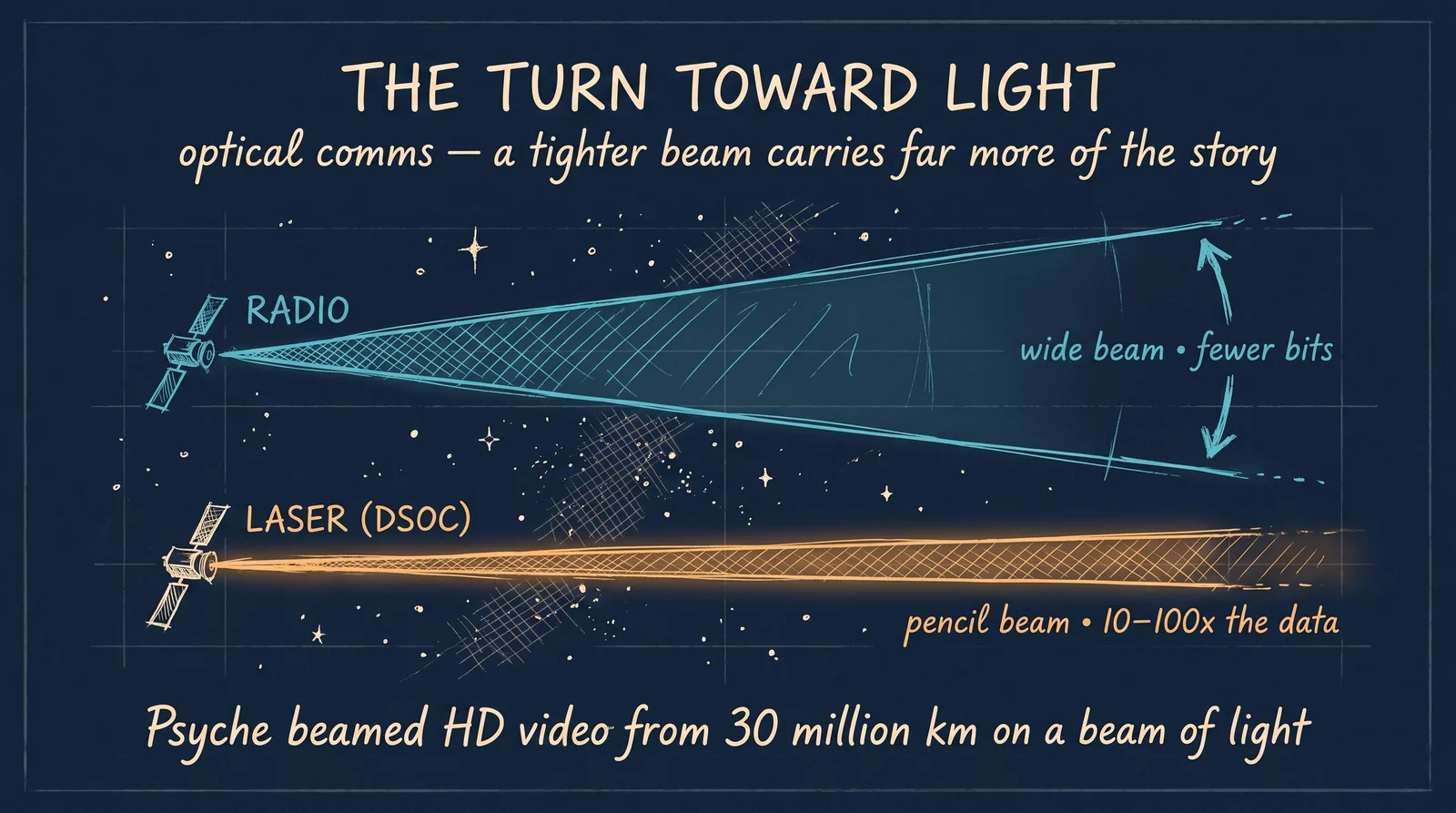
Every spacecraft talking to Earth uses radio — a well-understood technology that tolerates moderate pointing errors and passes through clouds. Its fundamental limit is bandwidth: radio frequencies are regulated and the physics of diffraction caps how tightly you can pack a beam. Optical communications replaces the radio carrier with a near-infrared laser. The same physics that makes the beam pencil-thin also concentrates the energy, so a given transmitted power delivers far more bits per second at the receiver.
NASA's Deep Space Optical Communications demonstrator (DSOC), flying aboard the Psyche spacecraft, showed what this means in practice. In late 2023 and early 2024, DSOC achieved downlink rates on the order of hundreds of megabits per second from tens of millions of kilometres — rates comparable to broadband fibre, from deep space. NASA's Laser Communications Relay Demonstration (LCRD), operating from geostationary orbit since 2021, proved the relay architecture: a space-based optical node that bridges spacecraft and ground terminals.
The advantages are real but the costs are steep. A beam narrow enough to carry high bandwidth is also narrow enough that a tiny pointing error misses the receiver entirely. Ground stations must track the spacecraft to microradian precision, and the spacecraft must point its laser at a moving target (Earth) while itself moving and rotating. Atmospheric turbulence and, most practically, clouds block optical wavelengths completely — so optical ground networks need either multiple geographically dispersed stations or a space relay to guarantee coverage.
Optical comms is a bandwidth technology, not a latency one. The photons still travel at the speed of light; a signal to Mars takes 4–24 minutes each way regardless of whether it is radio or laser. What changes is how much science data a single contact window can carry — and for missions returning petabytes of imagery or radar data, that difference is mission-defining.
SEE IN THE APP
- /missions Psyche mission — hosts DSOC, NASA's deep-space optical communications demonstrator