Arraying — many small ears instead of one giant one
Combining the signals from multiple antennas in real time creates a single virtual aperture larger than any individual dish, capturing fainter spacecraft signals without building ever-bigger structures.
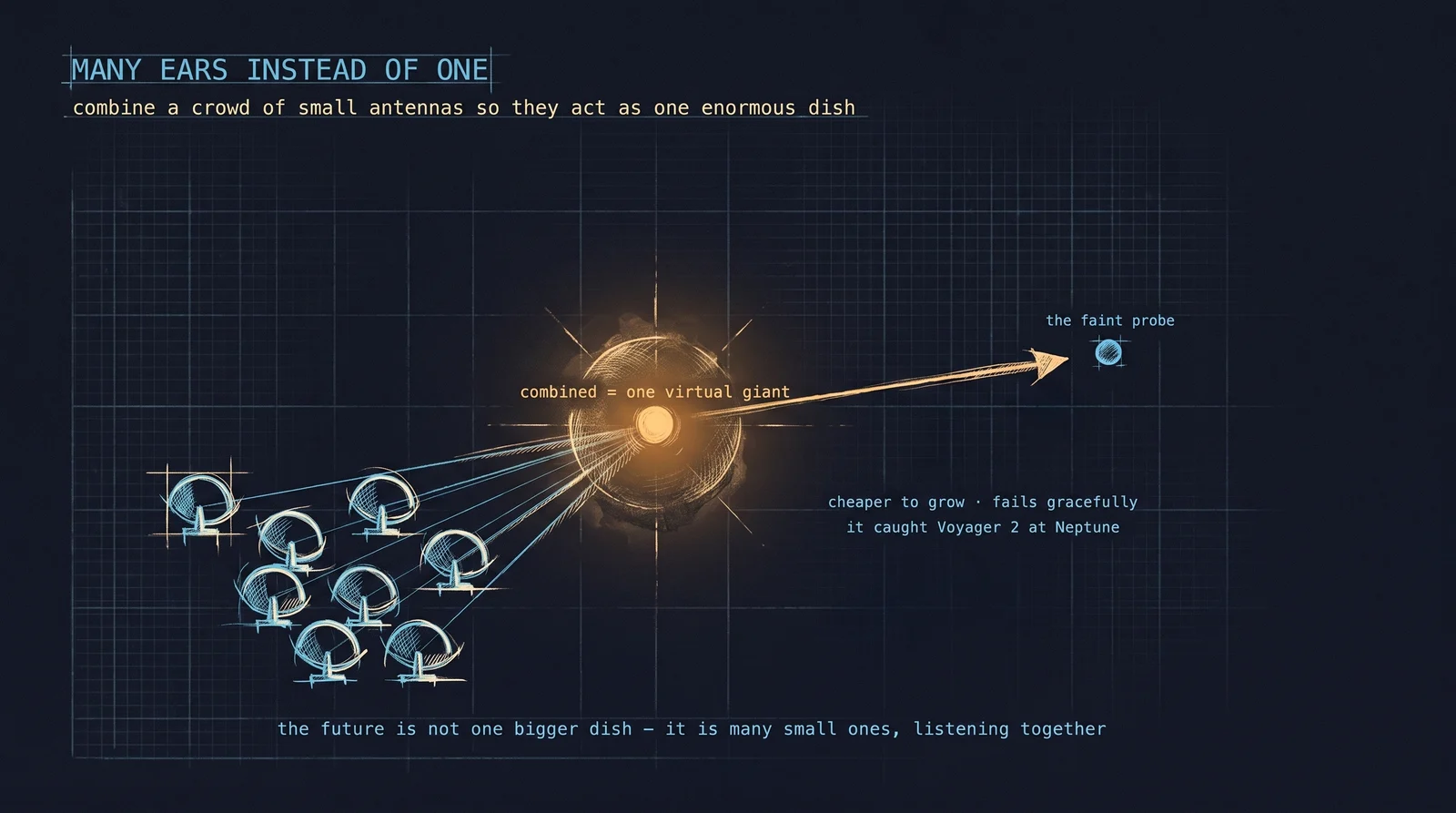
A single large antenna is the obvious way to hear a faint spacecraft signal from billions of kilometres away. The DSN's 70 m dishes — at Goldstone, Madrid, and Canberra — are near the practical limit for fully steerable, ground-based reflectors. Building something appreciably larger would require a fixed structure (limiting sky coverage) or engineering that doesn't yet exist. The alternative is to combine many smaller antennas: arraying.
When multiple antennas observe the same spacecraft simultaneously and their signals are combined with the correct phase and time offsets, the result is coherent addition. The noise from each antenna adds incoherently (it scales with the square root of the number of antennas) while the signal adds coherently (it scales with the number of antennas). The effective collecting area of an array of N identical dishes is N times that of a single dish. This is not an approximation — it is the same principle behind radio telescope arrays like the Very Large Array and ALMA.
The most famous demonstration in deep-space operations came during Voyager 2's Neptune flyby in August 1989. At 4.4 billion kilometres, Voyager's signal was so faint that capturing it at full science data rate required arraying dishes across four continents at once — the Goldstone 70 m and the Very Large Array in the United States, the 64 m Canberra DSN antenna and the Parkes 64 m radio telescope in Australia, and Japan’s 64 m Usuda dish. NASA's arraying agreement with non-NASA facilities like Parkes (operated by CSIRO) established that the deep-space communication network can be augmented internationally at critical mission moments.
Arraying has real costs and limits. Downlink arraying (receiving from a spacecraft) is tractable because each antenna independently captures the signal and the combination happens in post-processing or in real time with precise timing. Uplink arraying (transmitting to a spacecraft) is harder: the signals from multiple dishes must combine coherently at the spacecraft's location, far away, requiring extremely precise phase synchronisation across sites. NASA's DSN Aperture Enhancement Program is investing in more distributed arrays specifically because it is cheaper to add 34 m dishes than to build new 70 m ones — and an array of smaller dishes is also more fault-tolerant: losing one antenna degrades performance gracefully rather than losing a unique irreplaceable asset.
SEE IN THE APP
- /missions Voyager 2 — Neptune flyby (1989) used a multi-site array combining DSN + Parkes + Canberra to capture its faint signal