Communications Blackout
For a few minutes at the hottest part of re-entry, the air itself turns to plasma and swallows every radio signal — the capsule goes silent, and everyone on the ground can only wait.
101 · zoom in
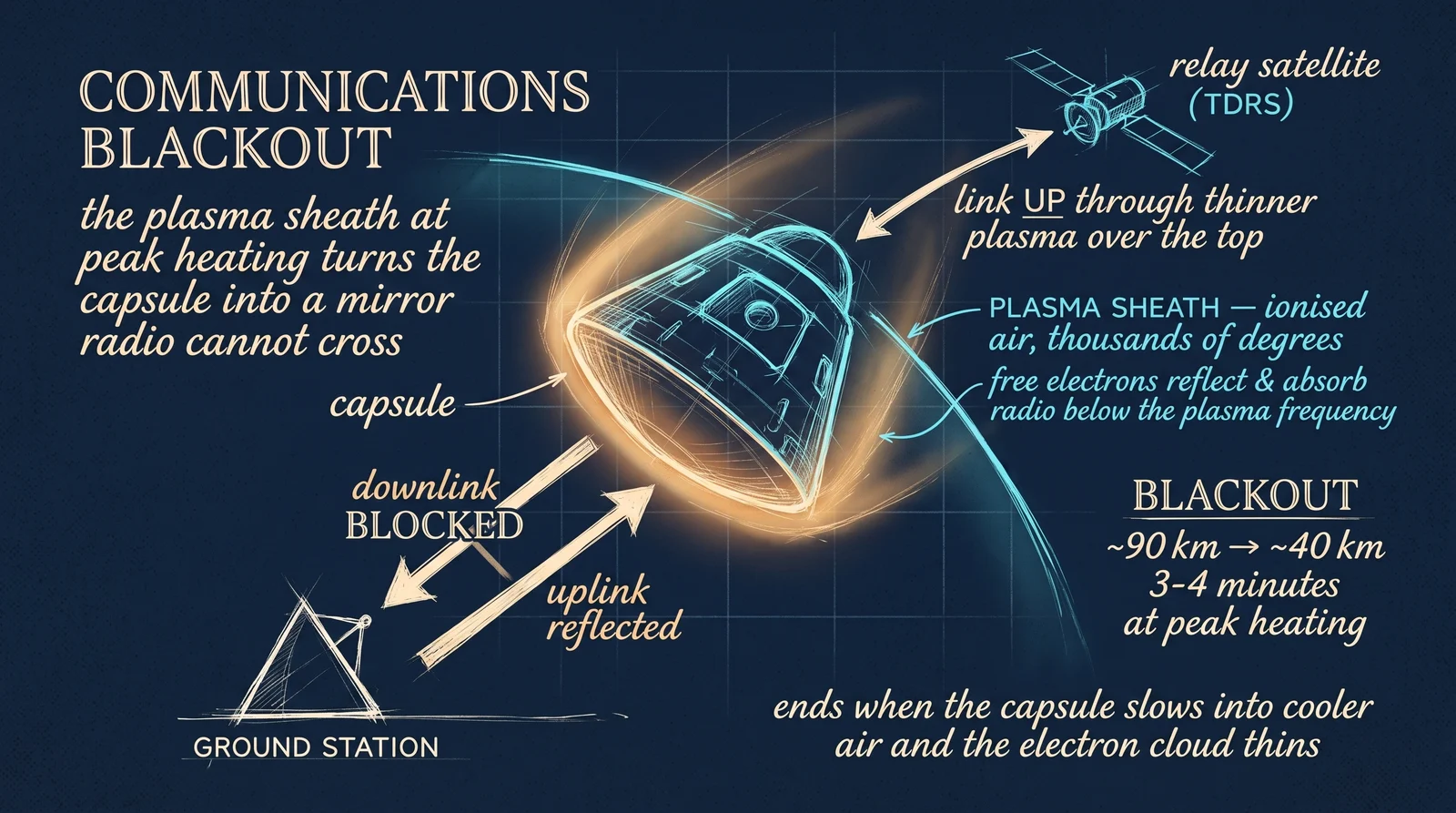
When a capsule slams into the atmosphere at orbital speed, it doesn't push the air aside — it can't, there isn't time. The air piles up in front of the heat shield, gets crushed and heated to thousands of degrees, and glows. That glowing sheath is the fireball you see streaking across the sky. But it isn't just hot: it's ionised. The heat rips electrons loose from the air molecules, and a cloud of free electrons is exactly what a radio wave cannot pass through.
So the capsule wraps itself in a mirror it can't see out of. Radio signals coming up from the ground bounce off the plasma; signals going down from the capsule can't get through it either. For the few minutes the heating is fiercest, the spacecraft is cut off — no voice, no telemetry, nothing. Mission Control watches a clock and a predicted track, and waits for the capsule to slow enough that the plasma fades and the crew's voice comes back. Glenn, Apollo, every Soyuz crew rode through that silence.
The blackout ends on its own: as the capsule decelerates and drops into thicker, cooler air lower down, the shock layer stops ionising, the electron cloud thins, and the radio link snaps back. The Space Shuttle cheated the problem — it talked upward through the thinner plasma on its top side to relay satellites in orbit, keeping a link when a downward signal to the ground would have been blocked.
The blackout is caused by the plasma sheath: the bow shock ahead of a blunt entry body compresses and heats the gas enough to ionise it, producing a layer of free electrons around the vehicle. A radio wave can only propagate through plasma above the local plasma frequency, which scales with electron density; during peak heating the electron density is high enough that this cutoff rises above the spacecraft's communication frequencies, and the signal is reflected and attenuated rather than transmitted. The link is lost in both directions.
For Earth-return capsules the blackout typically spans the altitude band from roughly 90 km down to about 40 km, lasting on the order of three to four minutes and coinciding with peak heating and near-peak deceleration. Its duration and severity depend on entry velocity, vehicle shape and the radio frequency in use — higher frequencies penetrate a given plasma density better, and the wake behind the vehicle is less ionised than the stagnation region ahead of the shield. Faster lunar-return entries produced longer, more complete blackouts than shallow LEO returns.
The classic mitigation is geometry: the Space Shuttle relayed through TDRS satellites overhead, transmitting through the thinner plasma over its upper surface rather than down through the dense sheath to a ground station. On `/fly`, the re-entry HUD marks the blackout window explicitly — the plasma indicator lamp lights through the peak-heating phase, the one stretch of the descent where the telemetry you're watching would, in a real mission, have gone dark.
SEE IN THE APP
- /fly Fly an Earth-return capsule (?descent=1) — the blackout lamp lights through the peak-heating phase where telemetry would go dark