Solar Sails — the only free push
A solar sail carries no propellant: it is pushed by the momentum of photons, making it the only propulsion system with an effectively unbounded specific impulse — and the only one that gets cheaper to run the longer it flies.
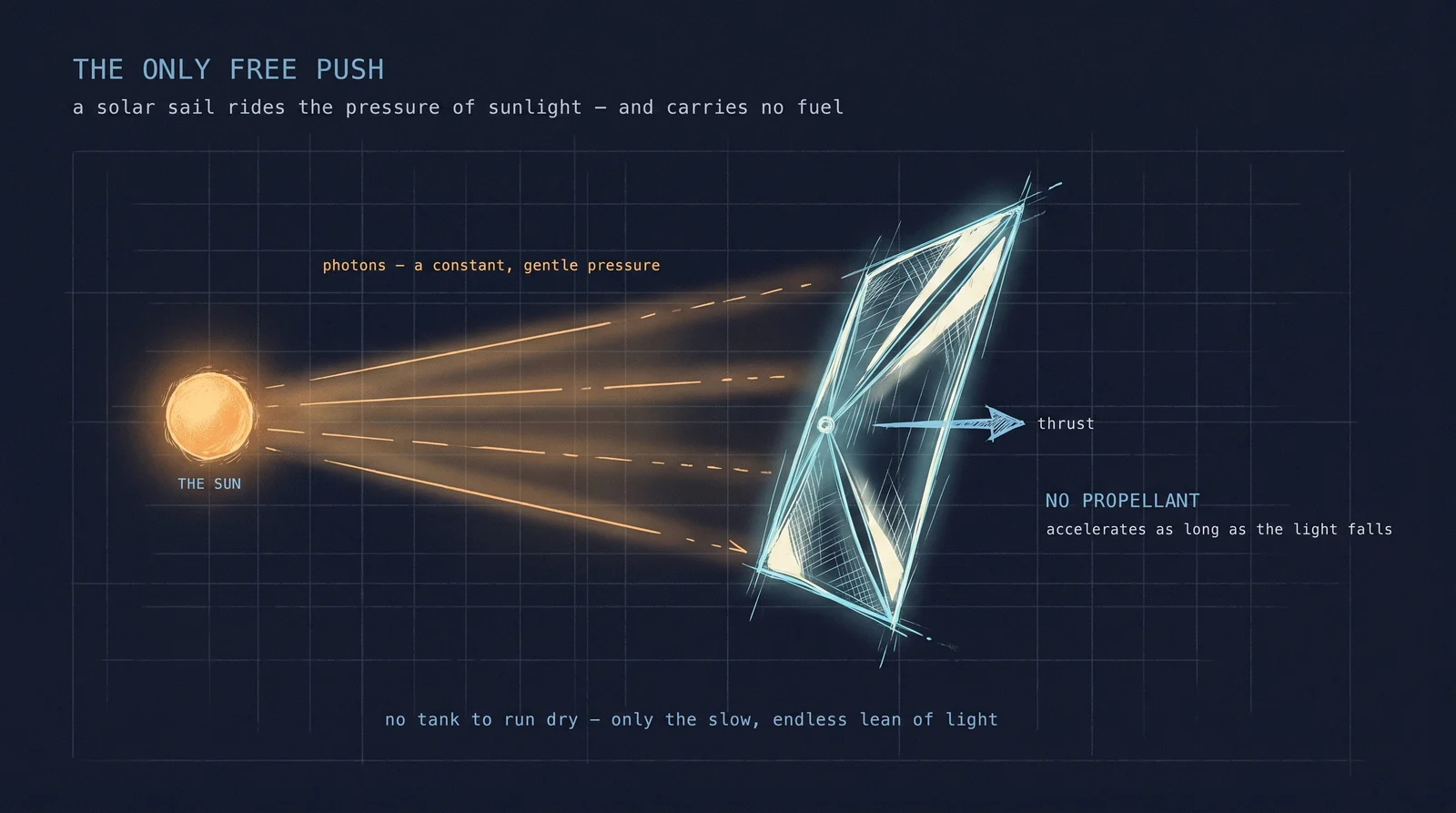
Light carries momentum. When a photon reflects off a mirror, it imparts twice its momentum to the mirror — a pressure called radiation pressure. In everyday life that force is negligible, but in space, where there is no air resistance, even a tiny continuous force accumulates into a real velocity change. A perfectly reflective 800 m² sail at 1 AU (Earth's distance from the Sun) receives about 5 millinewtons of force — the weight of a small grape. That is less than any ion engine produces, but it requires no propellant, no power system beyond basic housekeeping, and it never stops as long as the Sun shines.
Because the craft carries no propellant, the concept of specific impulse becomes mathematically infinite: there is no propellant mass-flow rate to divide the thrust by. A more useful figure is the sail's characteristic acceleration — thrust divided by total spacecraft mass. Current demonstration missions achieve fractions of a millimetre per second squared; scaling to large, lightweight sails could reach values competitive with ion drives for certain trajectory types. A solar sail can also tack: by tilting the sail at an angle, the component of thrust perpendicular to the Sun-spacecraft line can raise or lower the orbit, or spiral the spacecraft inward toward the Sun for a close solar flyby before heading outward on a hyperbolic trajectory.
The first spacecraft to fly by solar-sail propulsion in interplanetary space was JAXA's IKAROS, launched in May 2010 as a secondary payload on the Akatsuki Venus mission. IKAROS deployed a 196 m² polyimide sail just 7.5 micrometres thick — thinner than a human hair — and demonstrated measurable acceleration and attitude control by liquid-crystal panels embedded in the sail's edges. The Planetary Society's LightSail 2 (2019) became the first spacecraft to raise its orbit using only solar-sail thrust, demonstrating sustained propulsion in low Earth orbit. NASA's NEA Scout CubeSat (launched 2022 on Artemis I) was the first American interplanetary solar sail mission, though contact was not established after deployment. NASA's ACS3 mission (2024) demonstrated a larger composite boom structure for future scaling.
The fundamental limit is distance. Radiation pressure falls as the inverse square of distance from the Sun: at Jupiter (5.2 AU), it is 27 times weaker than at Earth. For trajectories beyond the asteroid belt, a sail needs to be very large or very light — or use a different power source. The natural successor concept is laser propulsion (sometimes called a laser sail or Breakthrough Starshot approach), where a ground- or space-based laser array illuminates the sail at far higher intensity than the Sun provides, enabling interstellar-class velocities. That remains speculative engineering; solar sails are flying hardware today. See also: /science/propulsion/specific-impulse and /essays/new-propulsion for where these ideas lead.
SEE IN THE APP
- /missions IKAROS (JAXA, 2010) — first interplanetary solar sail; LightSail 2 (Planetary Society, 2019) — first to raise orbit by sail alone