Antimatter — the perfect fuel we cannot make
Matter meeting antimatter annihilates completely, releasing energy no other reaction matches — a few milligrams could in principle drive an interstellar probe, yet humanity has made less than a nanogram of it in total.
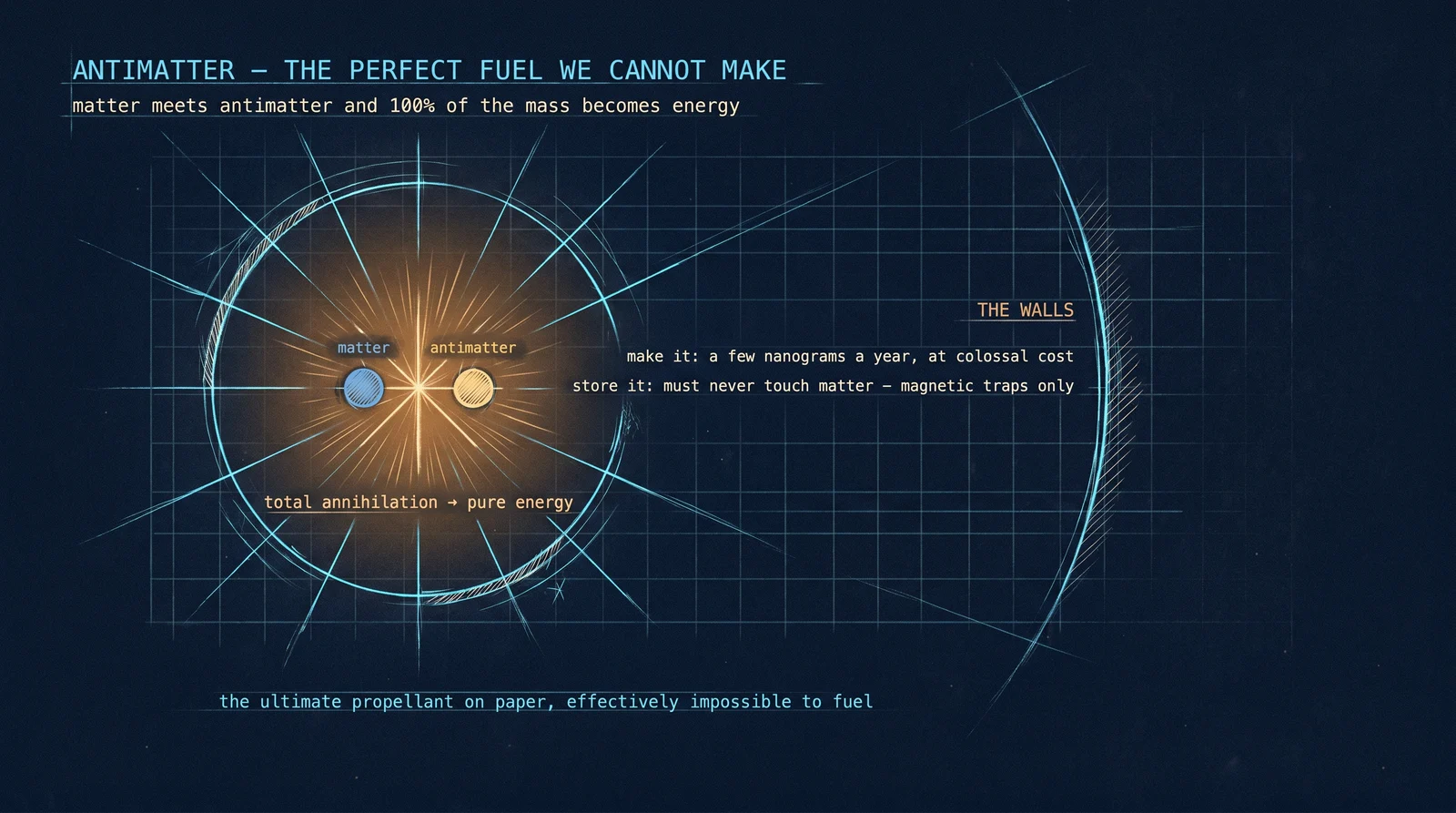
The energy case is exact, not approximate. When a proton meets an antiproton they convert entirely into pions, gamma rays, and lighter particles — E = mc² applied in full, with no chemical or nuclear residue. The energy density is roughly 10 billion times that of the best chemical propellant and roughly 1,000 times that of fission or fusion. A matter-antimatter annihilation drive with a magnetic nozzle to direct the charged pion exhaust could, in theory, reach specific impulse values in the millions of seconds and accelerate a spacecraft to a significant fraction of the speed of light.
Two problems make this theoretical perfection effectively unreachable with foreseeable technology. The first is production. Antimatter does not exist in useful quantities anywhere accessible — the observable universe appears overwhelmingly matter-dominated, and the reason for that asymmetry is one of the open questions in physics. Antimatter must be manufactured, atom by atom, in particle accelerators. CERN's Antiproton Decelerator produces roughly 10 to 15 nanograms of antiprotons per year at full operation. Scaling current production to the milligrams a probe would need, at current energy costs, yields estimates in the range of tens to hundreds of trillions of dollars per gram — and that assumes the energy is available, not that it is affordable.
The second problem is storage. Antimatter annihilates on contact with ordinary matter, which means it cannot touch any wall, any container, any trace of residual gas. The only known approach is magnetic or electromagnetic trapping — holding antiprotons in a Penning trap or antihydrogen in a magnetic bottle. The record for stored antihydrogen is measured in minutes to hours for small numbers of atoms. Storing milligrams for years-long transit, aboard a spacecraft that must survive launch vibration and radiation, is not a solved problem in any engineering sense.
Partial antimatter schemes — using antiprotons to catalyse fission or fusion reactions rather than fully annihilate — reduce the quantity required, but those concepts still need nanograms or micrograms and still face the same storage constraints. They have been studied on paper at NASA's Marshall Space Flight Center and elsewhere; none has progressed to hardware.
Antimatter propulsion is the limiting case of what physics permits. It sets the ceiling on how efficiently mass can be converted to thrust. It is worth understanding for exactly that reason — it tells you the best that thermodynamics will ever allow. But it is not a technology on any credible roadmap. The production problem alone puts it in a category closer to 'requires a different civilisation' than 'requires more funding'.
SEE IN THE APP
- /explore Interstellar distances that make the energy-density argument concrete