Fusion Propulsion — the star we cannot yet light
Fusing light atomic nuclei releases far more energy per kilogram than any chemical reaction, making fusion propulsion the most credible path to high-speed interstellar transit — if anyone can build a working fusion engine, which no one has.
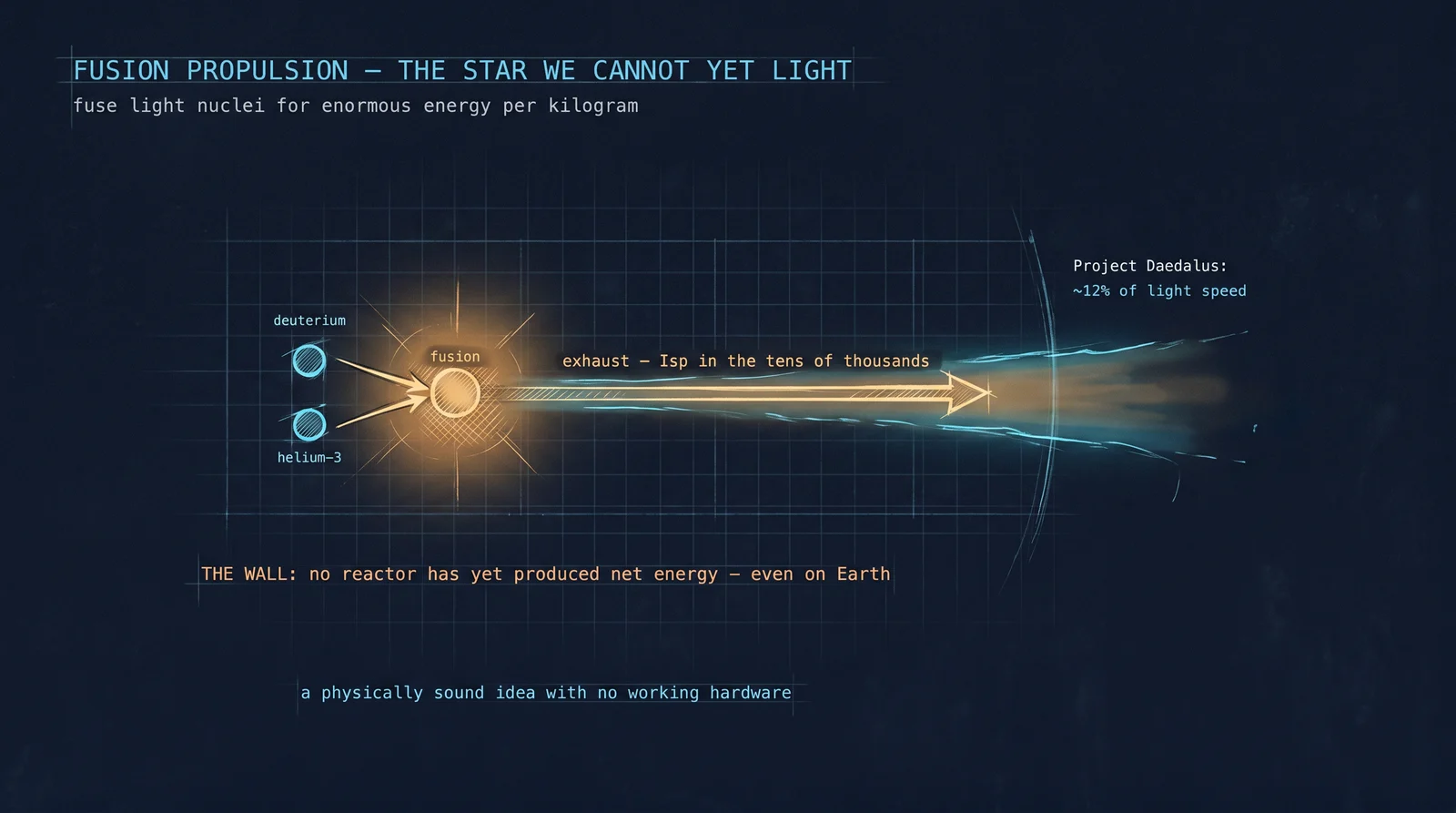
The physics is straightforward. Fusing deuterium and tritium (or deuterium and helium-3) converts a small fraction of their mass directly into energy. The yield per kilogram is roughly ten million times that of the best chemical propellant. Translated into specific impulse, a fusion drive could reach tens of thousands to hundreds of thousands of seconds — compare the best chemical engine at 450 s and the best ion drive at 9,000 s. That gap is the difference between a centuries-long interstellar trip and one measured in decades.
The most detailed engineering study to date is Project Daedalus, carried out by the British Interplanetary Society in the 1970s. The design used inertial-confinement fusion: pellets of deuterium and helium-3 ignited by electron beams, roughly 250 times per second, in a magnetic reaction chamber. The resulting spacecraft would have massed about 54,000 tonnes at launch — nearly all propellant — and reached approximately 12% of the speed of light, arriving at Barnard's Star (5.9 light-years away) in about 50 years, as an undecelerated flyby. Project Icarus, a follow-on study begun in 2009, revisited the design with the constraint of allowing deceleration on arrival; it found the mass requirements still harder to close.
The wall is fundamental, not incremental. No fusion reactor anywhere on Earth has yet produced more energy than it consumed — the long-sought 'ignition' threshold was crossed at the National Ignition Facility in December 2022 for laser-driven inertial confinement, but sustained net-positive output at useful scale remains unsolved. Scaling that to a flight-weight engine that fires hundreds of times per second is a different problem again. The helium-3 fuel Daedalus required does not exist in useful quantities on Earth and would need to be mined from the outer planets — itself a civilisation-scale project.
The two main confinement approaches each have their difficulties. Magnetic confinement (tokamaks, stellarators) requires superconducting magnets and sustained plasma control; ITER, the international tokamak under construction in France, is designed to demonstrate net energy but will not produce electricity. Inertial confinement requires drivers — lasers or particle beams — powerful enough to compress the fuel to stellar conditions; the ignition achieved at NIF required a precisely engineered capsule and is nowhere near the repetition rate a propulsion system needs. Neither approach has a clear engineering path to a propulsion application.
Fusion propulsion is physically sound and mathematically attractive. It is not engineering fiction — the numbers work on paper — but it has no working hardware, no demonstrated net-energy source to draw from, and no timeline. Any mission concept that relies on it is, honestly, a study of what becomes possible if the fusion problem is ever solved.
SEE IN THE APP
- /explore Outer solar system distances that make interstellar transit times vivid