Ion Drives — the slow push that never stops
Ion drives achieve specific impulses 10–30 times higher than chemical rockets by accelerating ionised gas electrically rather than burning it — at the cost of very low thrust that is measured in millinewtons, not meganewtons.
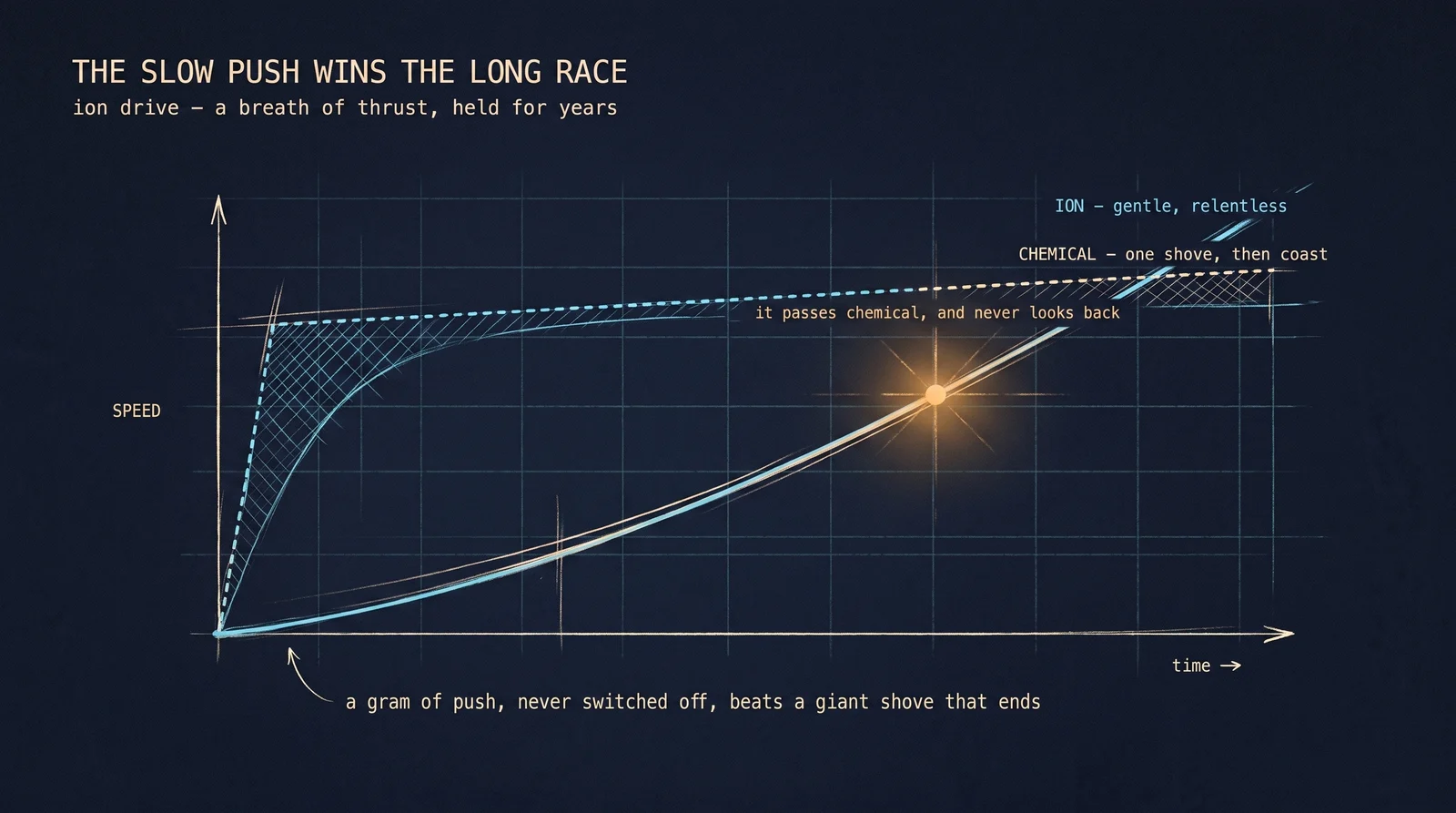
All rocket engines exchange propellant mass for velocity. The faster the exhaust leaves the nozzle, the less propellant you need for a given velocity change — which is what specific impulse (Isp) measures. Chemical engines are limited by flame temperature: the hottest practical propellant combination, liquid hydrogen and oxygen, reaches around 450 seconds of Isp. Ion drives sidestep that limit entirely. They ionise a propellant — typically xenon, chosen for its heavy atomic mass and chemical inertness — and accelerate the ions electrically or magnetically to exhaust velocities of 20–100 km/s, giving Isp values of roughly 3,000 to 10,000 seconds.
Two designs dominate flight use. Gridded ion engines (such as NASA's NSTAR) use a pair of charged metal grids to accelerate ions in a beam; the beam is neutralised by an electron gun to prevent the spacecraft from accumulating charge. Hall-effect thrusters confine electrons in a magnetic ring near the exit, and those electrons ionise and accelerate the propellant — a simpler arrangement with no grids to erode, which is why Hall thrusters have become the standard for commercial satellite station-keeping. NSTAR flew on Deep Space 1 and on Dawn; NASA's NEXT-C, a larger gridded engine, flew on the DART mission in 2021.
The thrust numbers are sobering. A state-of-the-art 12 kW Hall thruster produces about 0.6 newtons — roughly the weight of a small apple. You cannot lift a pencil off a desk with an ion engine. What you can do is run it continuously for months or years, because the propellant load is small and the power comes from solar arrays. Dawn's three NSTAR engines ran for a total of 2,009 days in flight, accumulating a velocity change of roughly 11.5 km/s — more than any previous spacecraft by propellant fraction alone. That was enough to brake into orbit around Vesta, escape it, and then brake into orbit around Ceres: a feat chemically possible only with a prohibitively large propellant load.
The constraint is power. In the inner solar system, large solar arrays can feed tens of kilowatts to a thruster. Beyond Jupiter, sunlight is too weak for solar-powered ion propulsion at useful thrust levels; the alternative is a nuclear reactor, which no electric-propulsion mission has yet used in deep space. At high thrust levels, ion drives are also slower to respond than chemical thrusters, which limits their use for attitude control or abort manoeuvres. They are a cruise engine, not a launch engine — every ion-propelled spacecraft in history rode a chemical rocket to orbit or escape velocity first. See also: /science/propulsion/specific-impulse for the numbers in context, and /science/propulsion/tsiolkovsky for why high exhaust velocity reduces propellant mass so dramatically.
SEE IN THE APP
- /missions Dawn used NSTAR gridded-ion drives to orbit Vesta and Ceres; DART flew NASA's NEXT-C Hall-effect thruster