Laser Sails — pushing a probe with a beam from home
Beamed propulsion inverts the usual logic: instead of carrying fuel, the spacecraft carries only a reflective sail, and all the energy is supplied by a laser or microwave array left behind on Earth or in orbit.
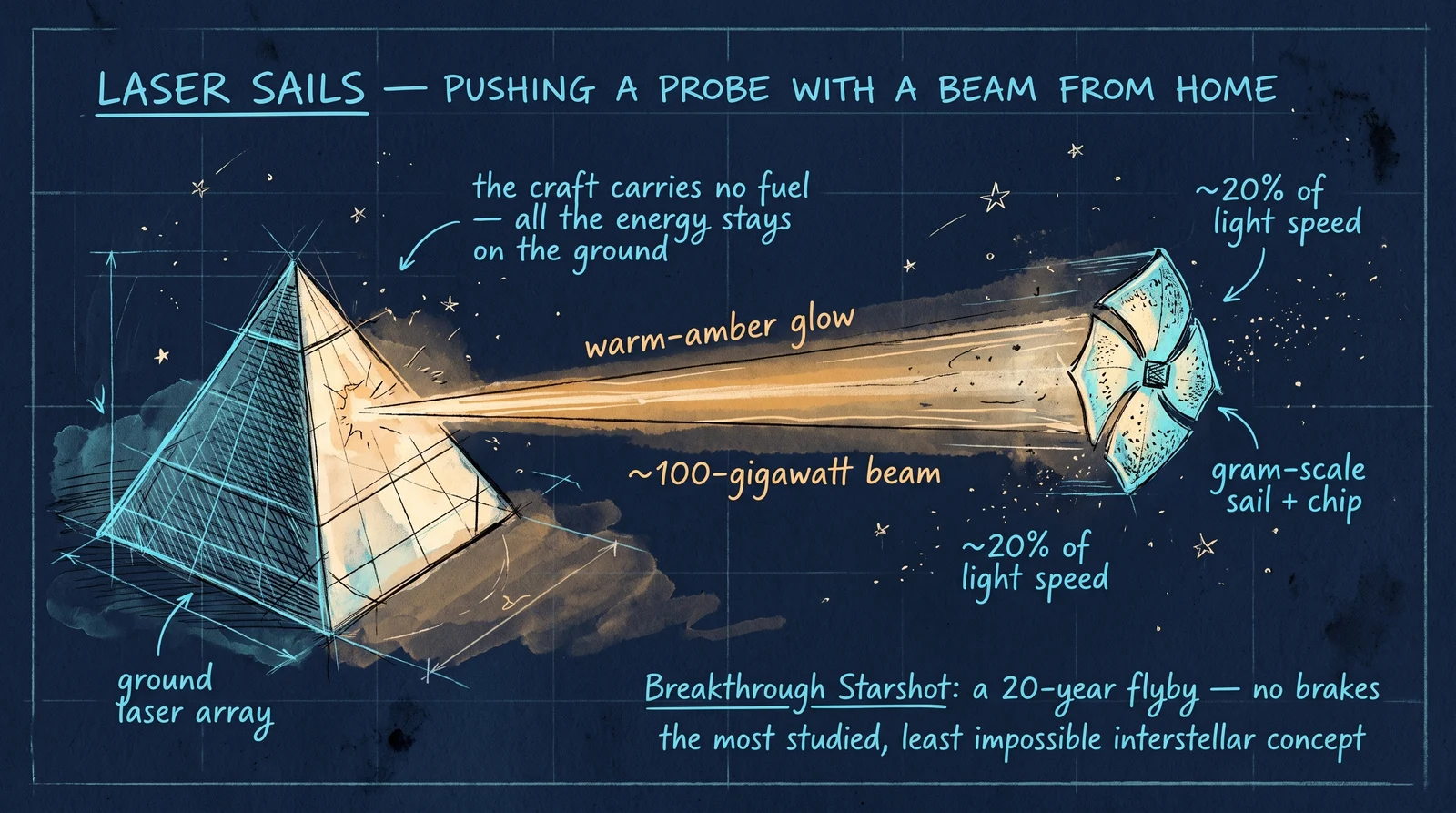
The core idea is momentum transfer. Light carries momentum, and when it reflects off a surface it transfers twice that momentum to the sail. A powerful enough beam can accelerate a lightweight sail to high speed without the spacecraft carrying any propellant at all. The Tsiolkovsky rocket equation — which punishes every gram of fuel you must first lift and then accelerate — does not apply; there is no exhaust, no fuel tank, no mass fraction problem. The energy bill stays at home.
Robert Forward worked out the mathematics in detail in the 1980s, proposing laser-driven sails for interstellar probes and the 'Starwisp' concept — a microwave-driven mesh sail carrying gram-scale electronics to the nearest stars. The best-known current version is Breakthrough Starshot, announced in 2016 by Yuri Milner and backed by Stephen Hawking among others. The design calls for 'StarChip' probes of a few grams on sails roughly four metres across, accelerated by a ground-based laser array of approximately 100 gigawatts to about 20% of the speed of light over a few minutes. At that speed, Proxima Centauri — 4.24 light-years away — would be reached in roughly 20 years.
The constraints are severe and honest. First, deceleration: a laser sail accelerated to 20% of light speed has no way to slow down at the destination. Breakthrough Starshot is designed explicitly as a flyby mission — a few hours of data collection at Proxima, no orbit insertion, no return. Forward's own proposals for decelerating used a second, larger sail left behind to reflect the beam forward onto a smaller braking sail; the engineering mass scales unfavourably. Second, communication: a gram-scale transmitter at 4 light-years must send a signal detectable by Earth's largest receivers. The link budget is marginal and requires the full 4-metre sail to double as a phased-array antenna. Third, survival: the sail must survive the acceleration phase (thousands of g over minutes), interstellar dust impacts at relativistic speed, and radiation over a 20-year cruise.
The laser array itself is the most immediate engineering challenge. 100 gigawatts is roughly the output of 100 large nuclear power plants, focused to diffraction-limited precision over a distance of millions of kilometres and held there for minutes without thermal distortion of the optics. No existing or funded facility approaches this. Breakthrough Starshot has produced detailed technical studies and funded relevant research (laser coherence, sail materials, chip design), but the programme is explicitly described as a 30-year technology development effort, not a near-term mission.
Of the three far-horizon propulsion concepts covered in this atlas, laser sails are the most studied, the least dependent on unsolved physics, and the closest to having a credible (if enormously ambitious) engineering path. The physics requires nothing beyond what is understood. The engineering requires a laser array, sail materials, and chip technology that do not yet exist at the required scale. It is the most honest candidate for 'hardest thing humanity might actually build someday' rather than 'requires a miracle'.
SEE IN THE APP
- /missions Voyager 1 and 2 as the only hardware to reach interstellar space — Starshot's target is 2000× faster