Nuclear-Thermal Rockets — heat, not flame
A nuclear-thermal rocket swaps the combustion chamber for a fission reactor: hydrogen heats in the core past any chemical flame and expands through a nozzle — roughly twice the specific impulse of the best chemical engines, at real thrust.
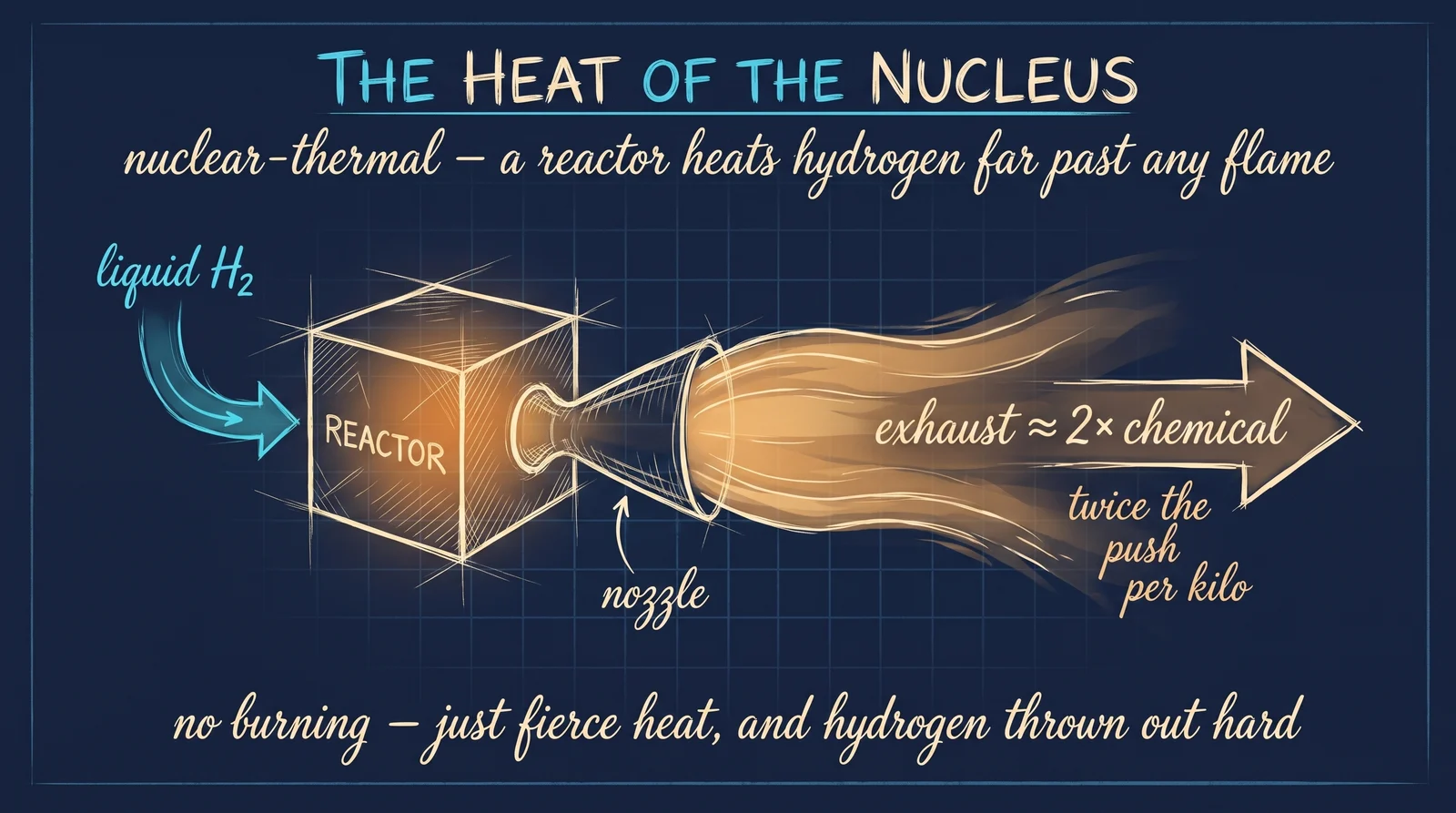
Chemical rocket engines are limited by how hot their propellants can burn. The hydrogen-oxygen reaction peaks around 3,500 K in the combustion chamber — already close to the melting point of most materials — producing a specific impulse of roughly 450 seconds in a vacuum. A nuclear-thermal rocket (NTR) is not limited by a chemical reaction. Liquid hydrogen flows through channels in a solid nuclear reactor core operating at 2,500–3,000 K, absorbs heat, and exits through a nozzle as a very hot, very light gas. Because hydrogen is the lightest element, its heated molecules move fast and produce high exhaust velocity. The resulting Isp is 800–1,000 seconds — more than double chemical — while thrust remains in the 50–250 kN range, far above any electric propulsion system.
That combination — high Isp with high thrust — is the gap NTR fills. Ion drives offer higher Isp but thrust measured in millinewtons; chemical engines offer high thrust but half the Isp. For missions requiring large velocity changes quickly — particularly a crewed transit to Mars — NTR's combination means a substantially smaller propellant load, a shorter trip, or both. A shorter Mars transit matters medically: less time in deep space means less accumulated radiation dose, which is one of the harder constraints on a crewed Mars architecture (see /essays/going-to-mars).
The engineering history is unusually complete for a technology that has never flown. The US NERVA/Rover programme (1955–1973) built and ground-tested 22 reactor configurations at Jackass Flats, Nevada. The Phoebus-2A engine in 1968 ran at 4,100 MW thermal for over 12 minutes — enough to lift the engine off the stand under its own thrust. NERVA XE-Prime demonstrated a flight-weight engine configuration. Programme management estimated that a flight-ready engine was within two years of the programme's 1973 cancellation. The Soviet Union ran a parallel programme (RD-0410, also called IRGIT) that similarly produced working test hardware without flying.
DARPA and NASA's DRACO (Demonstration Rocket for Agile Cislunar Operations) programme aimed to demonstrate an NTR engine in orbit by the late 2020s, using a Low-Enriched Uranium (LEU) design to sidestep some of the regulatory constraints that surrounded the highly enriched uranium in NERVA. The programme was cancelled in the 2026 US federal budget. As of 2026, no nuclear-thermal engine has flown. The technical obstacles are real but manageable: reactor mass, hydrogen storage and handling, nozzle erosion at high temperature. The persistent blocker has been political — public acceptance of launching a nuclear reactor, treaty obligations under the Outer Space Treaty, and the cost of testing that cannot be done on a standard engine stand.
For uncrewed deep-space missions, NTR competes with increasingly capable ion drives, which are cheaper to develop and carry no nuclear regulatory burden. The niche where NTR is hardest to replace is a crewed Mars mission with a tight launch window and a crew that cannot spend three years in transit. Whether that mission ever happens, and whether NTR is chosen for it over other options, remains open. See also: /science/propulsion/specific-impulse for how 800 s compares across engine types, and /science/propulsion/tsiolkovsky for why doubling Isp has such a dramatic effect on the required propellant fraction.