Transit-Timing Variations
In a crowded system, planets tug on one another and arrive early or late; the drift in transit times reveals unseen worlds and weighs the ones we see.
101 · zoom in
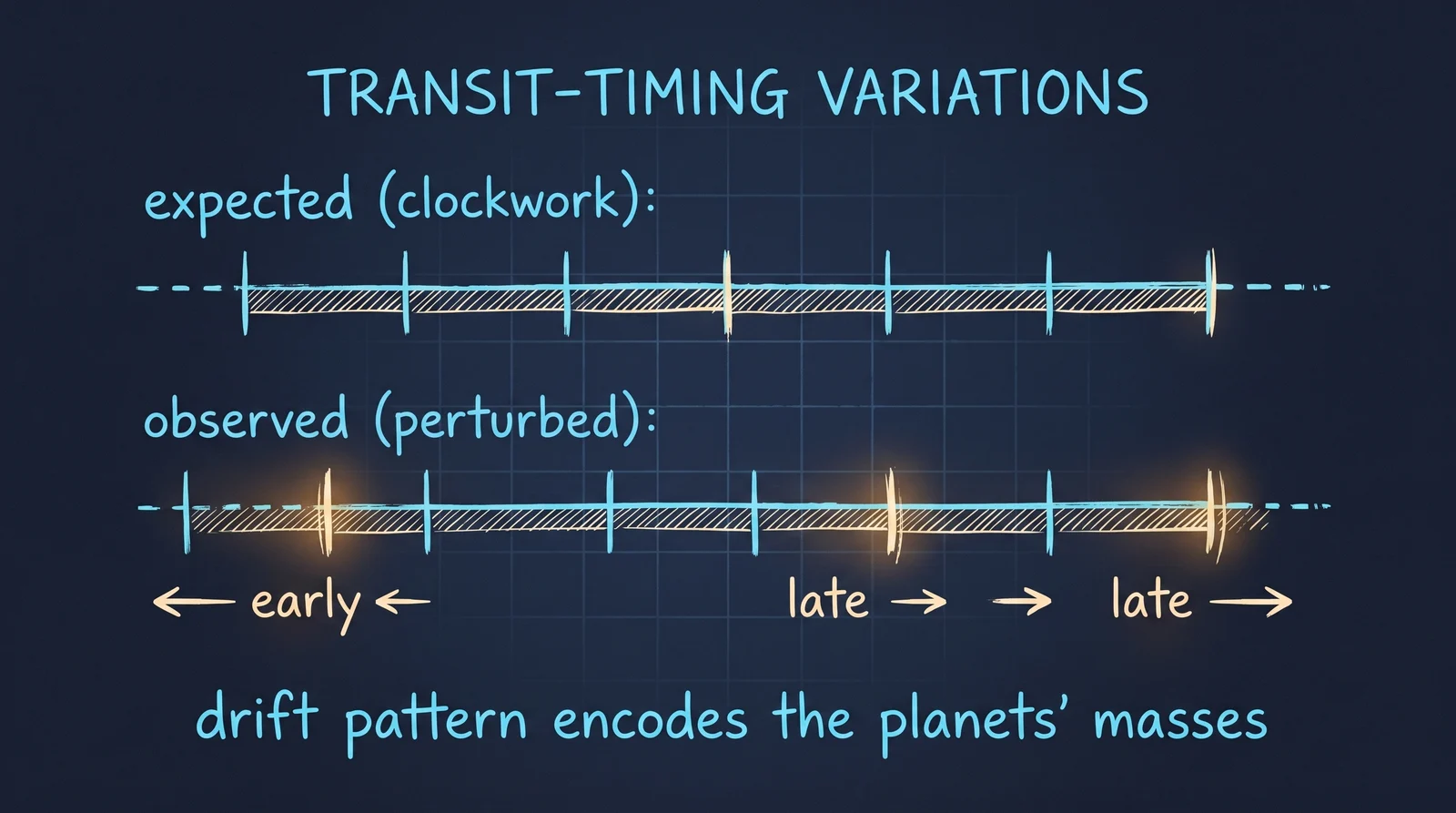
A lone transiting planet arrives like clockwork — same interval, every orbit. But put several planets in one system and their mutual gravity nudges each other, so transits creep a little early or a little late in a repeating pattern.
Those few-minute drifts are a gravitational signature. Model them and you can weigh the planets from their tugs alone — no spectrograph needed — and sometimes infer a planet that never transits at all, felt only through its pull on the others.
This is how the seven small worlds of TRAPPIST-1 were weighed: too faint for radial velocity, their masses came from the way they hurry and delay each other across the star.
Transit-timing variations (TTVs) exploit the gravitational interactions between planets in the same system. A perfectly isolated planet transits with a constant period; interacting planets show periodic deviations whose amplitude and pattern encode the planets' masses and orbits.
TTVs shine exactly where radial velocity struggles — around faint, small stars whose Doppler wobble is buried in noise — and they can reveal non-transiting planets by their influence alone. They are most sensitive near orbital resonances, where repeated close encounters amplify the tugs.
The method's masses complement transit radii to give densities, which is why compact resonant systems like TRAPPIST-1 and Kepler's multi-planet chains are so well characterised despite orbiting dim stars.
SEE IN THE APP
- /explore TRAPPIST-1's planet masses were weighed by how they tug each other's transit times