Astrometry
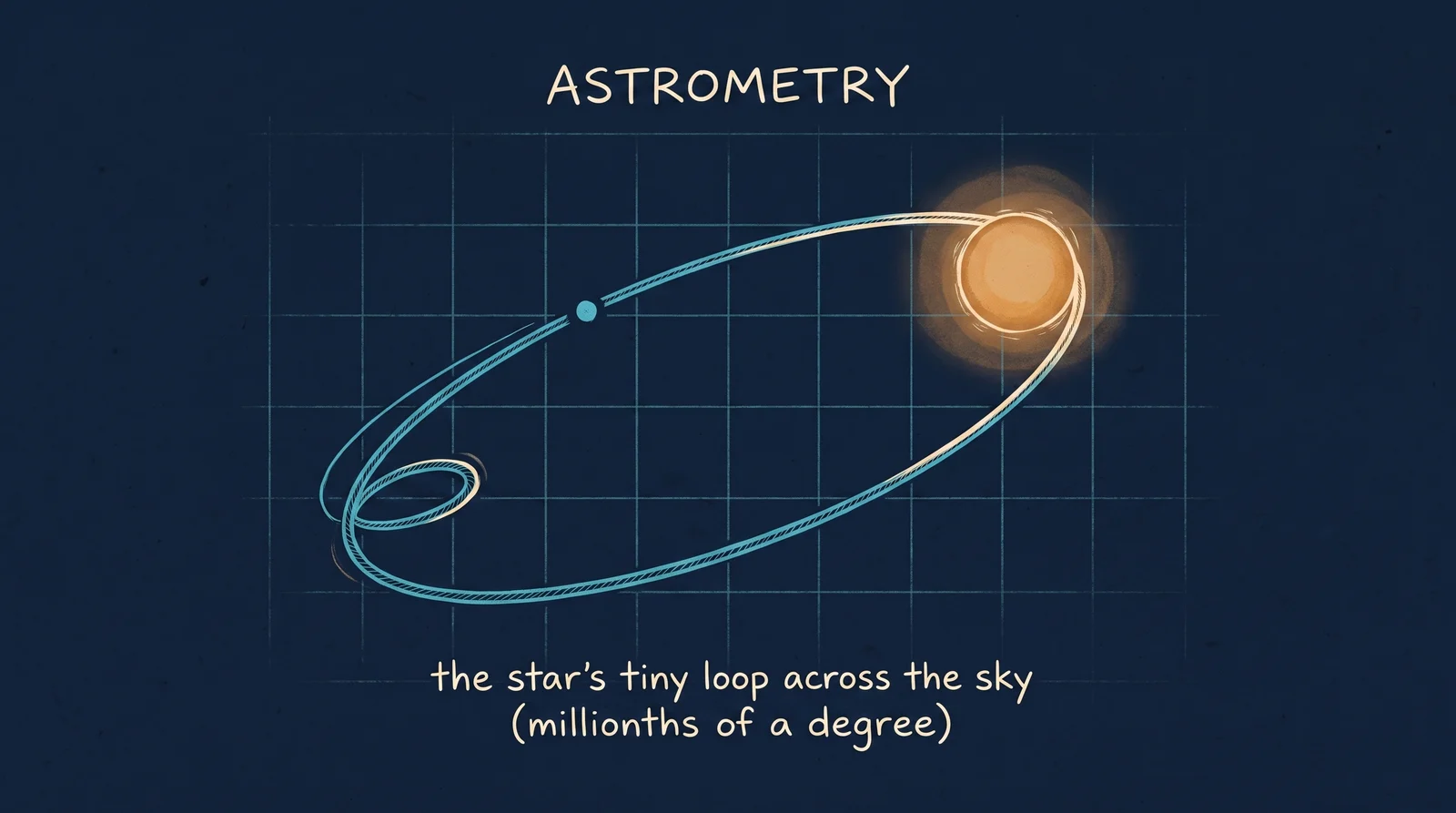
Track a star's exact position on the sky and you can see it trace a tiny loop as an unseen planet swings it around their shared centre of mass.
101 · zoom in
Radial velocity catches the star moving toward and away from us. Astrometry catches the other component — the star's side-to-side wobble across the sky as a planet pulls it around.
The loop the star traces is fantastically small, measured in millionths of a degree, which is why astrometry was long the great near-miss of planet hunting: promised for decades, delivering little, because the precision simply wasn't there.
Space astrometry has changed that. ESA's Gaia mission has mapped the positions of nearly two billion stars with the precision needed to feel a giant planet's tug — and is beginning to harvest planets from those wobbles.
Astrometry measures a star's periodic displacement on the plane of the sky as it orbits the system's centre of mass. Unlike radial velocity, it senses the full orbit regardless of orientation, so it yields a true mass (not just a lower bound) and works well for planets on wide orbits, where the astrometric signal grows.
Historically it produced more retractions than planets — Barnard's Star is the classic cautionary tale, its famous 'planets' from 1960s astrometry all spurious. The signal is simply tiny, and instrumental drift easily fakes it.
Gaia's all-sky, high-precision astrometry is now delivering genuine detections and, crucially, true masses for planets found by other methods — closing a chapter that stayed open for most of a century.
LEARN MORE
- intro Wikipedia · Astrometry
- core ESA · Gaia mission