The Transit Method
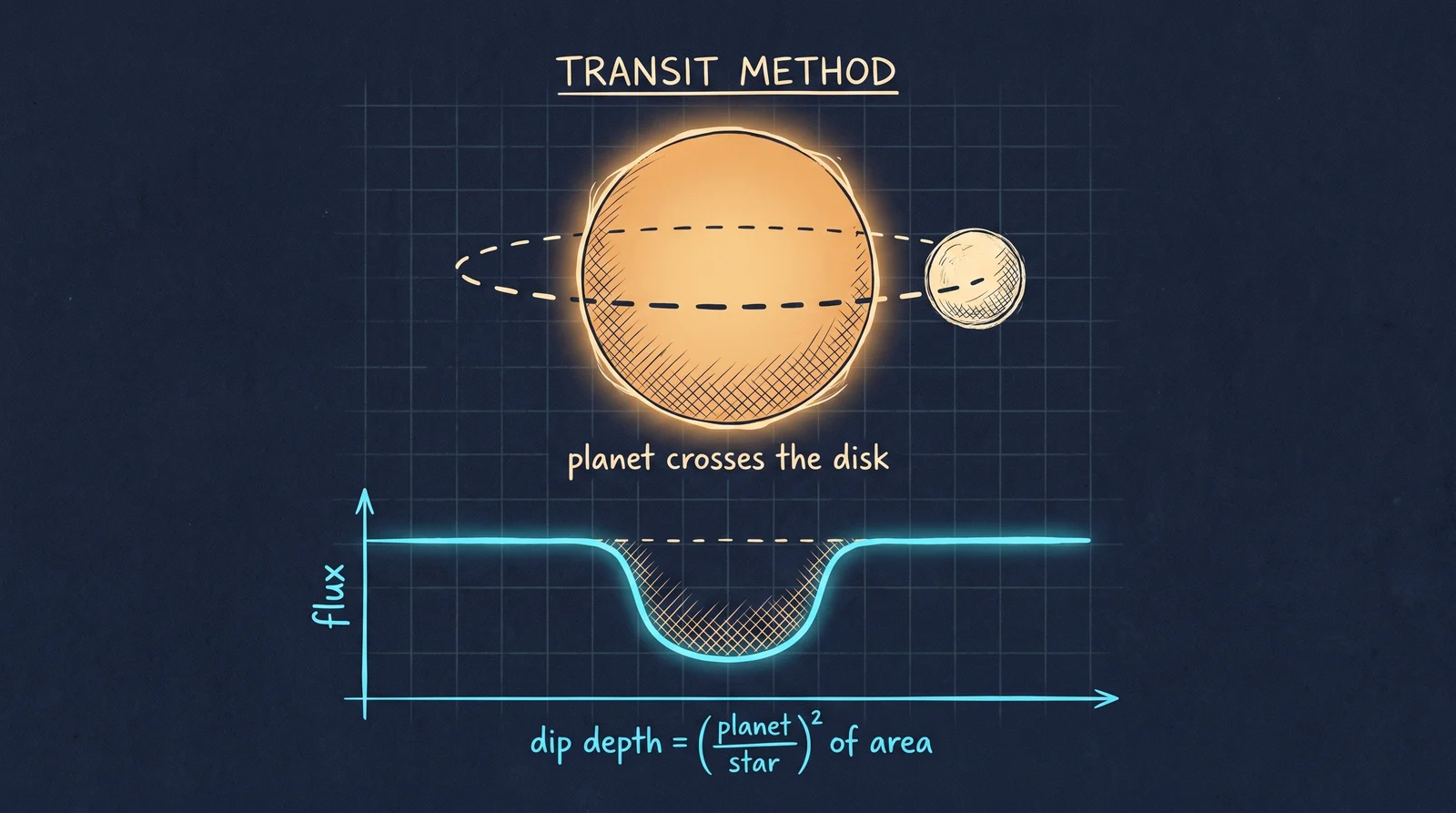
When a planet crosses in front of its star, it blocks a sliver of light; that periodic dip in brightness betrays the planet and measures its size.
101 · zoom in
If a planet's orbit happens to be edge-on to us, once per orbit it passes directly between us and its star — a transit — and the star dims by a tiny, precise fraction while the planet is in front.
The depth of that dip is just the ratio of areas: a bigger planet blocks more light. An Earth crossing the Sun dims it by about one part in ten thousand; a Jupiter, by one percent. Catch the dips repeating on a clock and you have a planet's size and orbital period.
Only a small fraction of systems are lined up for us to see transits — but survey enough stars and the numbers win. That is exactly what NASA's Kepler and TESS missions did, from space, staring at hundreds of thousands of stars at once.
Transit photometry is the most productive method by far, responsible for the large majority of known exoplanets. It measures a planet's radius directly (from the fractional dip in starlight) and its orbital period (from the spacing of the dips); combined with a radial-velocity mass it yields a bulk density.
Its bias is geometric — it only catches the minority of systems whose orbits we see nearly edge-on — and it favours large planets on short periods, which transit more often and more deeply. False positives from eclipsing binaries and stellar activity mean transits are usually confirmed by a second method.
Beyond discovery, a transit is a door into a planet's air: during the crossing, a thin ring of starlight filters through the planet's atmosphere and imprints the fingerprints of its gases — the technique the James Webb Space Telescope now uses to sniff exoplanet skies.
SEE IN THE APP
- /explore TRAPPIST-1 — seven transiting worlds found by the dimming they cause