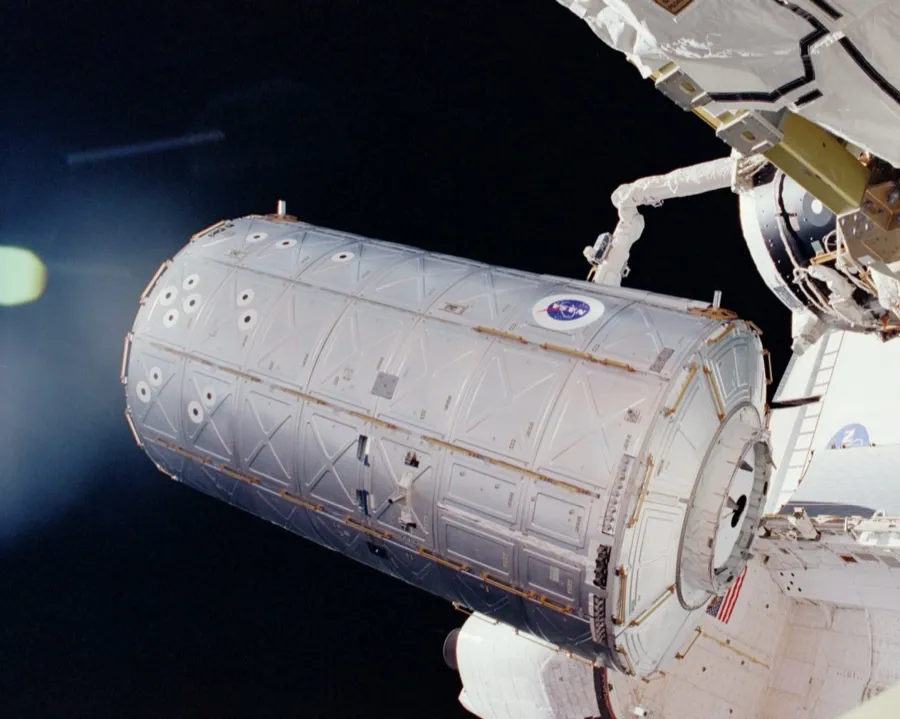
Habitable Volume
The total habitable interior of a station — how much room the crew actually has to live and work.
101 · zoom in
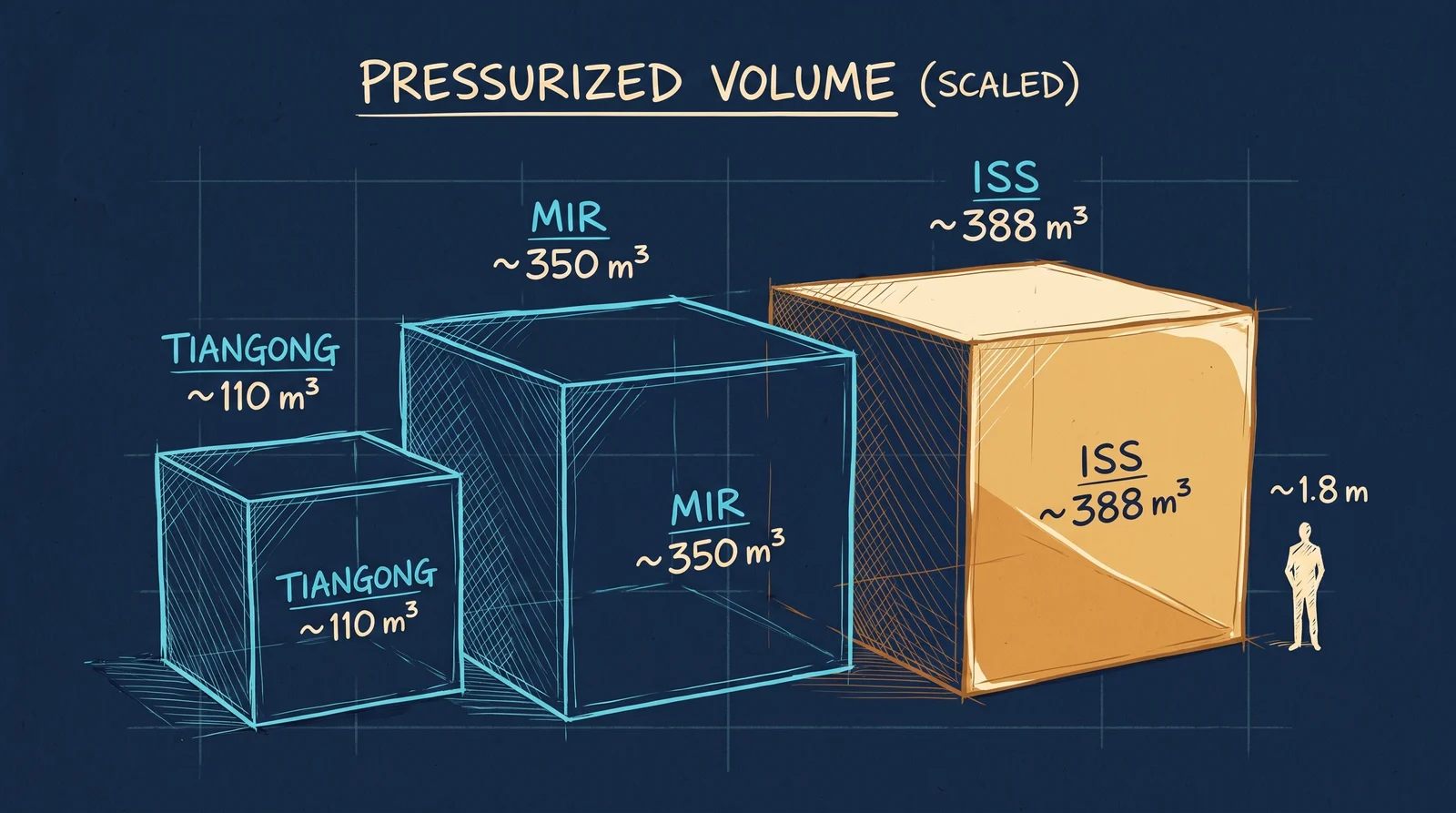
Every station spec sheet leads with one key number: habitable volume in cubic meters — the inside of the modules that crew can breathe and move around in, summed across the whole station. The ISS habitable volume is roughly 388 m³ (about the size of a large 3-bedroom house). Tiangong comes in at about 122 m³ — comfortable for three crew, tight for six.
Pressurized volume is bounded by two ceilings: launch-vehicle fairing diameter (you can only ship a module as fat as the rocket can lift) and pressure-shell mass (the thicker the wall, the heavier the launch). Modern composite-aluminum hulls hit a sweet spot at 2-4 mm thick. Anything beyond and you're paying mass for safety margin you don't use; anything thinner and a micrometeoroid might puncture you.
Crews need roughly 15–25 m³ per person of net habitable volume for multi-month missions (NASA-STD-3001 net-habitable-volume guidance is duration-dependent, not a single fixed value). ISS and Tiangong both comfortably exceed the minimum — which sounds excessive until you remember that the crew is awake 16 hours a day, every day, for months on end.
Habitable volume is the air-filled usable interior of a space station, measured in cubic meters. It excludes structural racks, bulkheads, and equipment volume — the figure usually quoted is gross internal volume, of which 30-50% is occupied by hardware.
ISS: ~388 m³ habitable across 16 pressurized modules (Zarya, Zvezda, Unity, Destiny, Quest, Pirs/Nauka, Harmony, Columbus, Kibo + ELM, Tranquility, Cupola, Leonardo PMM, Bigelow BEAM, plus the Russian Rassvet and Poisk). Total pressurized volume is ~916 m³.
Tiangong: ~122 m³ habitable across three modules (Tianhe core, Wentian and Mengtian labs). Total pressurized volume is ~340 m³.
Mir: ~350 m³ total pressurized volume at peak (1986–2001) — broadly comparable in scale to Tiangong's pressurized envelope, but built from heavier-walled modules and an older generation of life-support systems.
The net habitable volume guidance in NASA-STD-3001 Volume 2 is empirically derived from confined-environment psychology studies dating back to Skylab and the Soviet Salyut programme, and scales with mission duration rather than setting a single floor. Below the minimum guidance band, crew well-being and mission performance decline measurably.