Node Module
A pressurized hub with multiple docking ports — the structural connector that lets a station branch.
101 · zoom in
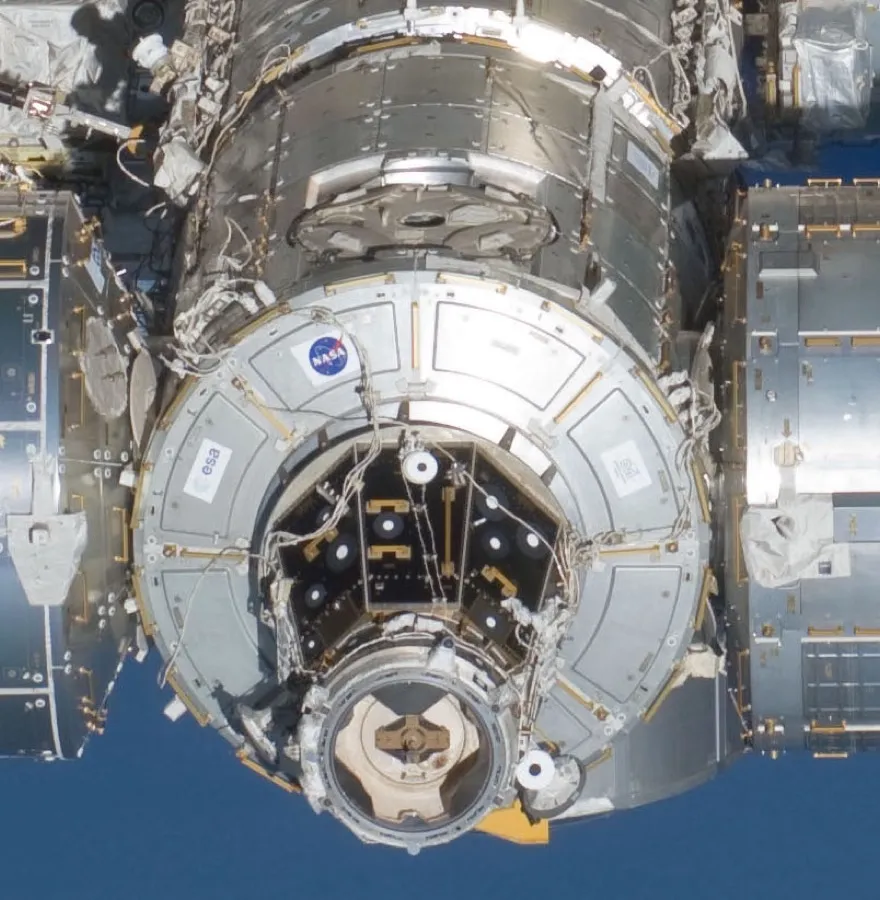
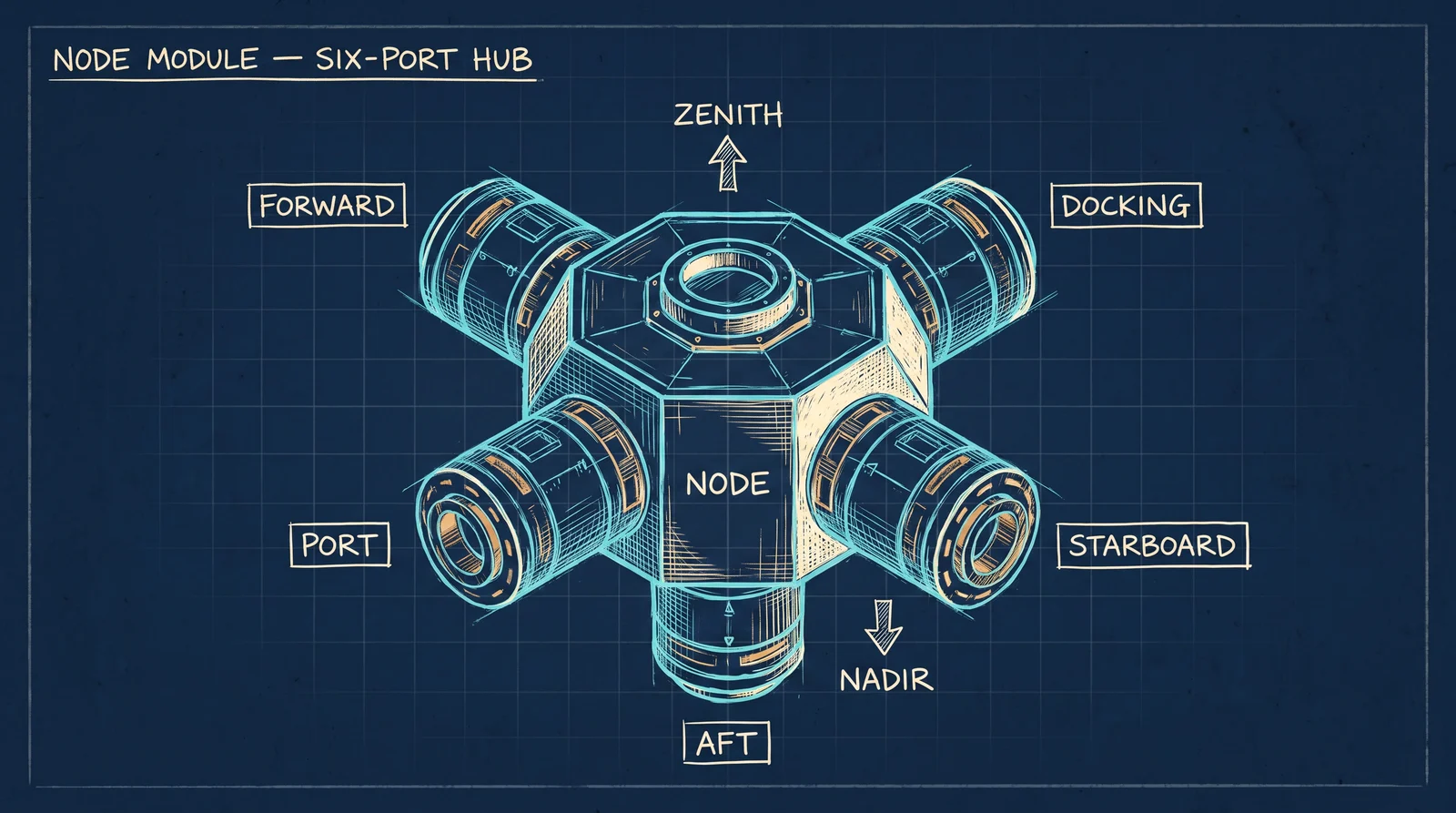
A node is a special kind of pressurized module: it doesn't host experiments or crew quarters, it just connects other modules together. Picture a hexagonal box where each face has a docking port. Bolt one node to a launching rocket, send it up, then dock five more modules to the five remaining ports and you've grown your station from one module into six.
The ISS has three: Unity (Node 1), Harmony (Node 2), and Tranquility (Node 3). Each one is the central junction for one segment of the station — Unity glues the Russian and US sides together; Harmony connects the US lab cluster to the Japanese and European modules; Tranquility carries the Cupola observation dome.
Tiangong took a different approach: instead of dedicated nodes, the central Tianhe module acts as both living quarters and a hub, with multiple docking ports built directly into its forward and aft ends. It's a tighter design that costs less mass to launch but limits how many modules can branch off.
Nodes are connector modules — pressurized hubs with multiple Common Berthing Mechanism (CBM) or docking ports — that allow a station to branch into a tree topology rather than a linear chain.
ISS Unity (Node 1) launched in 1998 on STS-88. Six CBM ports: forward → Destiny, aft → Zarya, starboard → Quest airlock, zenith → Z1 truss, port → Tranquility (2010), nadir → PMA/cargo berthing (formerly Leonardo PMM 2011–2015). The first US-built ISS module.
ISS Harmony (Node 2) launched 2007. Six ports: connects Destiny to Columbus (port), Kibo (starboard), and the two docking adapters (IDA-2 forward, IDA-3 zenith) for Crew Dragon / Starliner.
ISS Tranquility (Node 3) launched 2010. Hosts the Cupola observation dome (nadir port), the Permanent Multipurpose Module Leonardo (forward), and BEAM (aft).
Tiangong's Tianhe core: combines node + crew quarters + propulsion + control. The node hub carries a forward axial port (Shenzhou), two lateral radial ports (Wentian to starboard, Mengtian to port, both relocated there by the arm), and a nadir port; the aft axial port takes Tianzhou cargo. Ports use the Chinese Docking Mechanism, not the US CBM.