Regolith — the dust of airless worlds
Regolith is the loose blanket of fragmented rock and glass dust that covers the Moon, Mercury, and most asteroids — ground down by billions of years of micrometeorite bombardment, with no wind or water to round its edges.
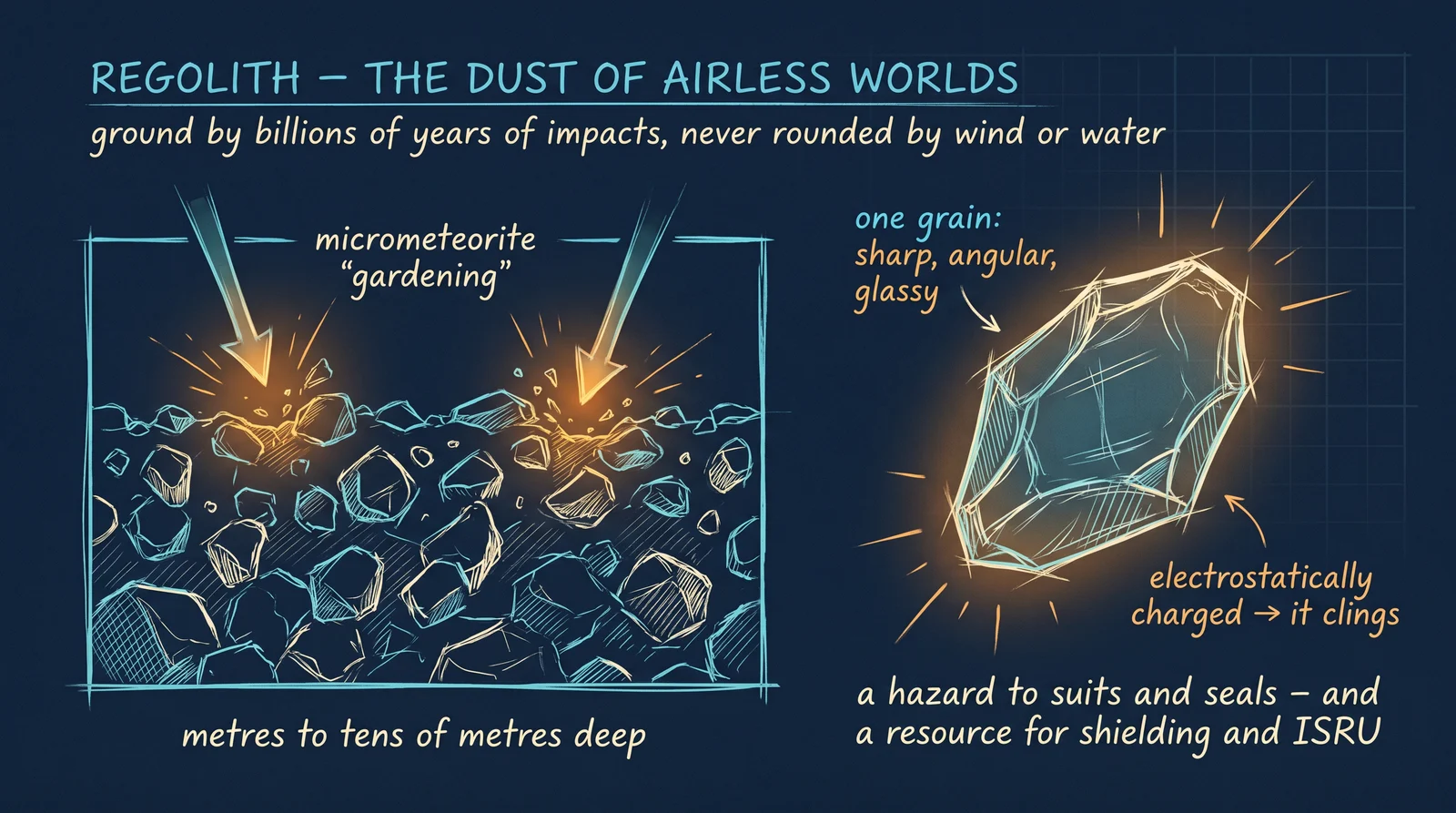
On Earth, sediment grains are rounded and smoothed by water and wind over time. Airless bodies have neither, so their surfaces are abraded purely by impactors — from multi-kilometre asteroids down to interplanetary dust grains arriving at tens of kilometres per second. The result is a layer of angular, glassy shards called regolith, ranging from fine powder to house-sized boulders. On the Moon this layer runs from a few metres deep in the highlands to tens of metres in the maria.
Lunar regolith has a property that makes it actively dangerous: it is electrostatically charged. On the Moon’s dayside, ultraviolet sunlight knocks electrons off the grains by the photoelectric effect, leaving the sunlit surface positively charged; on the nightside, electrons from the solar wind charge it negatively. Either way the grains carry a persistent electrostatic charge. Dust sticks to everything — visors, suit joints, instrument optics, thermal radiators. Apollo astronauts found their suits grey-black within hours of their first moonwalks, and abrasion by sharp grains degraded suit seams over the course of a single EVA.
For future surface operations, regolith is both threat and resource. As a hazard it can clog mechanical joints, scratch optical surfaces, and if inhaled, sharp glassy particles lodge in lung tissue like asbestos fibres. As a resource it is available in essentially unlimited quantity: bulk regolith can shield habitats from cosmic radiation and micrometeorites without launching any material from Earth. Processed regolith can in principle yield oxygen, metals, and silicon — the basis of in-situ resource utilisation (ISRU).
Asteroid regolith presents its own physics. On rubble-pile bodies like Bennu (sampled by NASA's OSIRIS-REx in 2020) and Ryugu (sampled by JAXA's Hayabusa2 in 2018), gravity is so weak — millionths of Earth's — that regolith barely coheres. OSIRIS-REx's sample arm sank unexpectedly deep into Bennu's surface, revealing a body less like a solid rock and more like a loosely packed bag of gravel. How material moves, consolidates, and behaves under such conditions is still an active area of research.
The depth and composition of regolith also record planetary history. The rate of impact gardening — the churning of the surface by successive impacts — can be used to date surfaces: denser crater counts mean older, less-churned terrain. Trace elements delivered by comets and the solar wind are preserved in regolith grains in a way that eroded Earth rocks cannot preserve them, making returned samples irreplaceable archives of early solar system chemistry.