Lunar Ice — water in the permanent dark
Near the lunar poles, some crater floors have never seen sunlight — and in that perpetual cold, water ice delivered by comets and asteroids over billions of years has accumulated and been trapped.
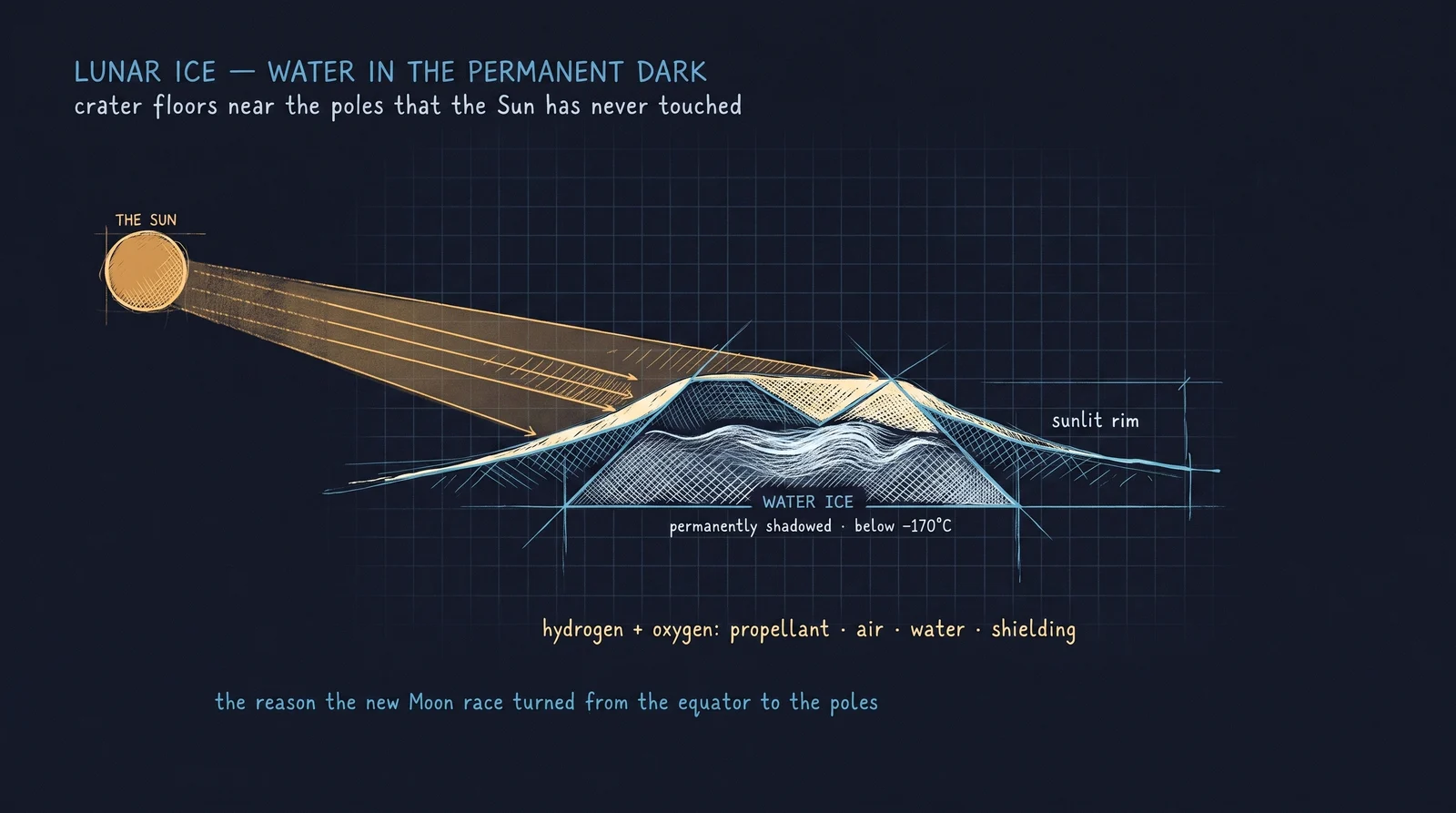
The Moon's axial tilt is only about 1.5 degrees, far less than Earth's 23.5 degrees. As a result, sunlight near the poles arrives almost horizontally, and the floors of deep polar craters fall permanently in shadow. These permanently shadowed regions (PSRs) are among the coldest places in the solar system: measured temperatures run below 100 K (−170°C), and some spots near the lunar south pole approach 40 K. At those temperatures, water ice is stable for billions of years — it simply does not sublimate.
Evidence for water in PSRs has been assembled by several missions. India's Chandrayaan-1 carried NASA's Moon Mineralogy Mapper (M3) instrument, which in 2009 detected the spectral signature of hydroxyl and water molecules at the surface across a range of latitudes — including sunlit terrain, where the solar wind may be creating water by implanting hydrogen into oxygen-bearing minerals. Most dramatically, NASA's LCROSS mission in 2009 deliberately crashed a spent rocket stage into a PSR near the south pole and observed the resulting plume with a following spacecraft; the plume contained water vapour and ice, directly confirming the presence of water in the cold trap.
Estimates of total water ice in lunar PSRs vary — figures in the range of hundreds of millions to billions of tonnes have been published — but the exact amount, depth profile, concentration, and physical form (pure ice, ice mixed with regolith, or thin frost layers) remain uncertain. The ice appears to be heterogeneous: patchy, mixed with dirt, and not a uniform layer. ISRO's Chandrayaan-3 landing in 2023 targeted the south polar region partly to begin characterising this terrain at close range.
The strategic significance is straightforward. Water is H2O: split it and you have hydrogen and oxygen — the most energetic chemical rocket propellant combination known. You also have breathable air and drinking water. Lunar polar ice, if accessible and extractable at scale, would make the Moon a potential fuel depot for missions throughout cislunar space and beyond, dramatically reducing the mass that must be launched from Earth. That shift in economics is the central reason that NASA's Artemis program, ESA, ISRO, Roscosmos, and CNSA all target the south pole rather than the equatorial sites of Apollo.
Access is the hard part. The coldest, darkest terrain on the Moon is also the most difficult to reach and operate in. Rover solar panels generate little power in near-permanent shadow. Equipment must survive extreme thermal cycling between the illuminated crater rim (needed for power) and the shadowed floor (where the ice is). Drilling or mining in low-gravity regolith without contaminating the ice is an unsolved engineering problem. The science is settled enough to motivate a race; the engineering is not.