Our galaxy — the Milky Way from the inside
We live inside a barred spiral galaxy of a few hundred billion stars, and we have never seen it from the outside. Everything we know about the Milky Way's shape is reconstructed from within the disc, looking through it.
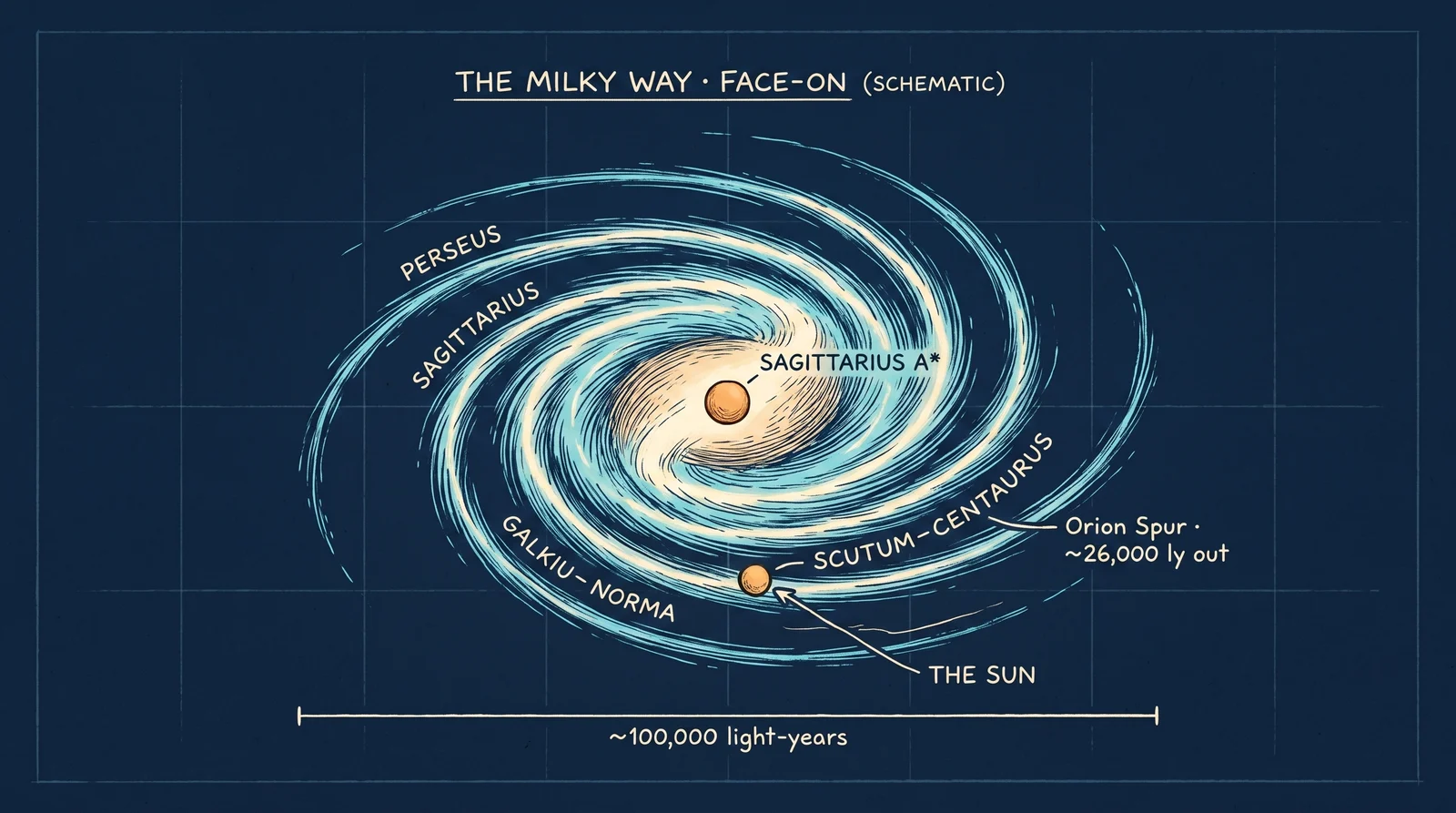
The Milky Way is a flat, rotating disc about 100,000 light-years across but only ~1,000 light-years thick — a cosmic vinyl record. Its stars, gas, and dust are wound into spiral arms (Perseus, Sagittarius, Scutum-Centaurus, Norma, plus our own minor Orion Spur), trailing from a central bar of older stars. Wrapping all of it is a spherical halo of ancient globular clusters and the invisible dark-matter that dominates the galaxy's mass. Estimates of the star count run from 100 to 400 billion.
The Sun is not special and not central. It sits about 26,000 light-years — roughly halfway — out from the core, on the inner edge of the Orion Spur, orbiting the galactic centre at about 230 km/s. Even at that speed one lap — a “galactic year” — takes ~230 million years; the Sun has completed only about 20 orbits in its entire existence. The last time it was here, dinosaurs were just beginning.
At the very centre, 26,000 light-years away in the direction of Sagittarius, lies Sagittarius A* — a supermassive black hole of about 4.3 million solar masses. We know its mass precisely because we have watched individual stars whip around it on decades-long orbits, and in 2022 the Event Horizon Telescope imaged its shadow directly. Every star in the galaxy, the Sun included, orbits this one point.
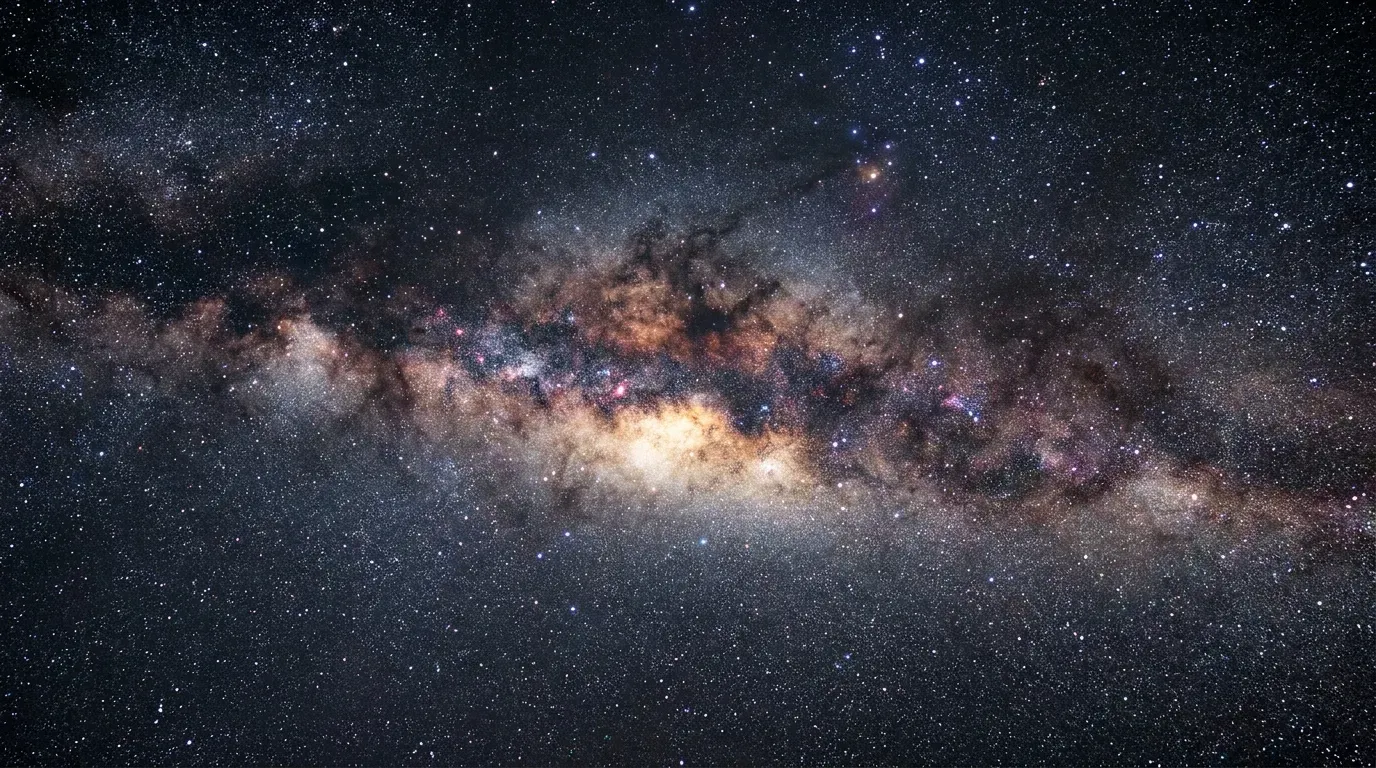
Seeing the whole thing from inside is hard: interstellar dust blocks visible light toward the centre, so the disc's structure is mapped in infrared and radio, which pass through. The band of light we call “the Milky Way” in a dark sky is simply the combined glow of the disc's billions of stars, viewed edge-on from our seat within it — the plane of our own galaxy, seen the long way.
Mapping it is the great project of modern astrometry. ESA's Gaia mission has measured precise distances and motions for nearly two billion stars, turning a fuzzy impression of spiral arms into a moving three-dimensional model — and revealing that the Milky Way is still digesting smaller galaxies it has swallowed, its disc gently warped and rippling from the collisions.
SEE IN THE APP
- /explore Milky Way context: the face-on schematic — spiral arms, the bar, and Sagittarius A* at the core